
Arboricultural Impact Assessments for Sydney DAs.
Arboricultural Impact Assessment Sydney — DA arborist reports
The arborist report council asks for when you build near a tree. Written to AS 4970:2025 by an AQF Level 5 consulting arborist. Most reports are $1,500–$2,000 ex GST, quoted the same day from your plans.
★ 5.0 from 70 Google reviewsAQF Level 5 arboristsISO 9001 certified$20M public liability
The report that decides whether your design keeps its trees, or loses months at council.
An Arboricultural Impact Assessment (AIA) is the arborist report that goes with a development application. It surveys every tree on your site and every neighbouring tree whose roots reach into it, measures how far the building, driveway, pool and services cut into each root zone, and tells council which trees can stay, how they will be protected, and which ones go. Get it right and the trees stop being an argument. Get it late and the design gets redrawn.
Knockdown rebuilds and extensions
A new house, granny flat, garage or second storey where a protected tree sits near the footprint, the driveway or the path of the sewer.
Pools, driveways and retaining walls
Excavation is where root zones get hurt. Council will want to know what a pool shell or a cut for a retaining wall does to the tree next to it.
Subdivisions, townhouses and commercial sites
Multi-tree sites where the tree schedule, retention values and protection plan shape the layout. This is the work we did through to final certification at Minto.
Bring the arborist in before the plans are finished.
The most expensive AIA is the one ordered after the architect has finished. By then the footprint is fixed, and if it sits on a tree’s structural roots the report can only say so. Council then asks for the tree to be retained, the design to change, or for evidence that the tree will survive, and every one of those costs weeks.
The current standard, AS 4970:2025 Protection of trees on development sites, replaced the 2009 edition and puts the arborist at the concept stage for exactly this reason. We measure and map the trees first, give your designer the root zones as dimensions on the survey, and then assess the final plans. The design is drawn around the trees rather than argued over them afterwards.
How a root zone is measured, with a worked example.
Everything in an AIA comes back to two circles drawn around each tree. Here is how they are calculated, using a typical Sydney gum with a 600 mm trunk.
Notional Root Zone (NRZ)
12 × trunk diameter at 1.4 m. A 600 mm trunk gives a 7.2 m radius, about 163 m² of ground. The radius is never less than 2 m or more than 15 m. Under the 2009 standard this circle was called the TPZ.
Structural Root Zone (SRZ)
(D × 50)0.42 × 0.64, where D is the trunk diameter just above the root flare, in metres. With 700 mm at the base, the SRZ radius is 2.85 m. These are the roots that hold the tree up.
Tree Protection Zone (TPZ)
The area actually fenced and protected on site. Under AS 4970:2025 the arborist sets it from the NRZ and the design, and it is what the tree protection plan, the fencing and the hold-point inspections enforce.
On that same 600 mm tree, the standard sorts encroachment into three bands:
- Minor, up to 10% of the NRZ (about 16 m²) and outside the SRZ. A driveway edge clipping the circle usually falls here, and the report sets out the protection needed.
- Moderate, over 10% and up to 20% (about 16 to 33 m²), still outside the SRZ. The arborist has to review the design, assess whether the tree stays viable and specify how the impact is reduced. Root mapping may be needed to show it.
- Major, over 20% or anything inside the 2.85 m SRZ. Design alternatives have to be explored and the tree’s survival demonstrated with investigation, typically non-destructive root mapping. Without that, council will treat the tree as lost.
The changes that usually keep a tree and a design together.
Most conflicts are solved with construction detail, not by moving the house. These are the options an AIA can recommend, and your engineer or builder can price.
Pier-and-beam or screw-pile footings
Point footings placed between the major roots, with the slab or beam bridging above them, instead of a strip footing trenched straight through the root plate.
Suspended slabs and decks
Raising a floor, deck or path clear of the existing ground so the soil and roots beneath are left alone.
Boring services under the roots
Sewer, stormwater and power run by under-boring or hand excavation through the root zone, not an open trench dug by machine.
Paving on the existing grade
Permeable paving built up on top of the current soil level, with no excavation, so water and air still reach the roots.
Shifting a wall or a driveway
Sometimes a one-metre shift on the plan takes an encroachment from major to minor. It is a cheap change at concept stage and a costly one after lodgement.
Root investigation
Where the numbers are close, exposing the roots with air or water under supervision shows where they actually are. Real root positions often allow more than the circle suggests.
Texco, Minto: from the first assessment to the final sign-off.
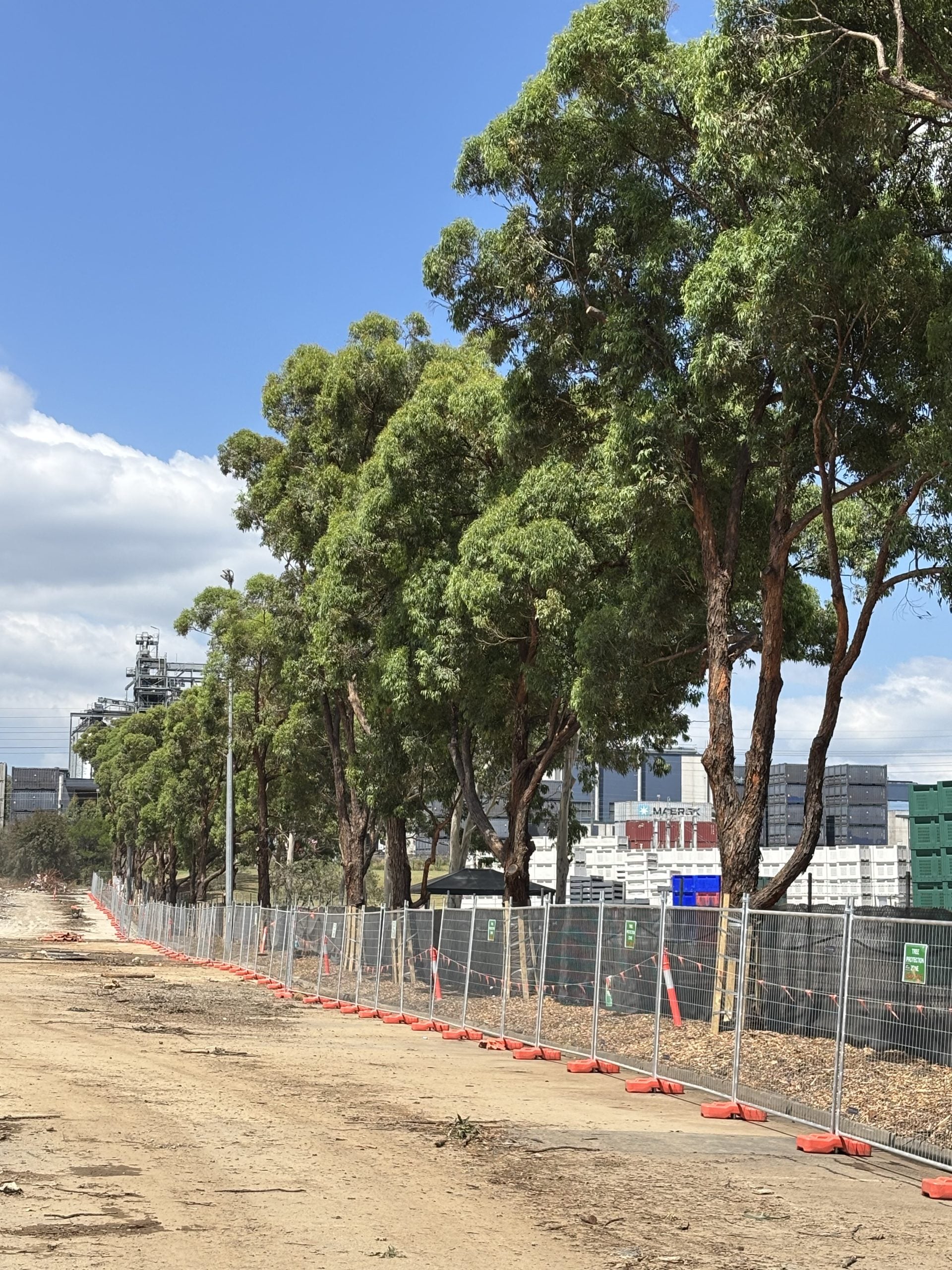
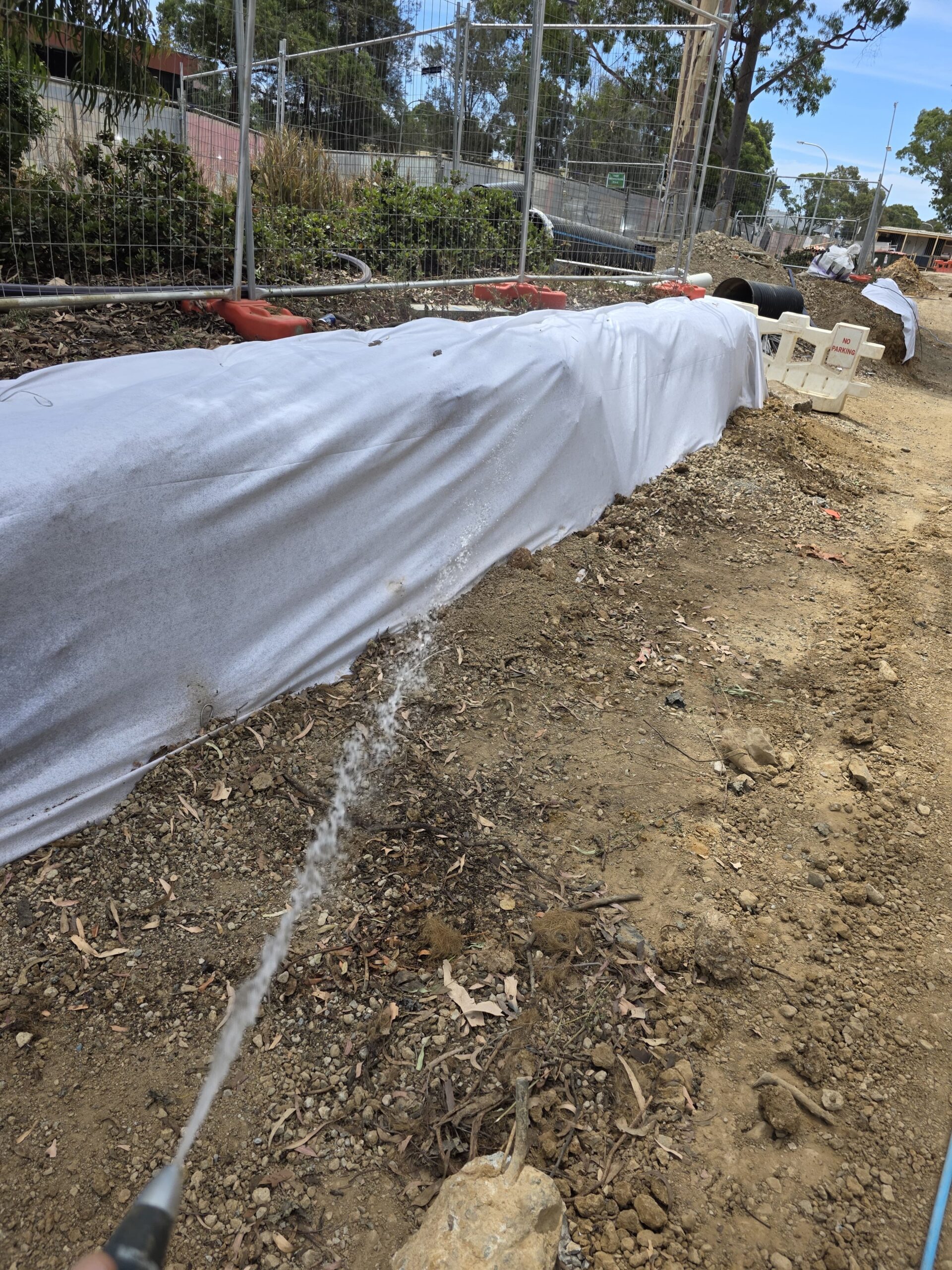
True Roots was the consulting arborist on a commercial Texco development at Minto. We wrote the initial Arboricultural Impact Assessment, acted as the project arborist through construction and provided the final certification on completion, managing the Tree Protection Zone across a two-year build. Where excavation exposed roots of retained trees, they were wrapped in geotextile, kept moist and protected behind fencing until they could be backfilled.
That is the full arc a DA consent actually asks for. The assessment gets the approval, but the consent conditions are what the builder has to live with, and the certifier will want the arborist’s sign-off before the occupation certificate. Having the same arborist from report to certificate means nobody has to reinterpret someone else’s recommendations halfway through the job.

What council gets when we lodge an AIA.
Tree schedule
Every tree in scope, on your site and next door, numbered on the survey with species, height, canopy spread, trunk diameters, health and structure.
Retention value
Each tree rated with a recognised method such as IACA STARS, so council can see which trees matter most and why.
NRZ and SRZ overlays
Both root zones drawn over your architectural plans, with the encroachment worked out as a percentage for every tree affected.
Impact assessment
What the footprint, excavation, services, level changes and site access will do to each retained tree, and whether it will survive.
Protection measures
Fencing, ground protection, trunk and branch protection, construction methods inside the root zone, and the hold points where the project arborist must inspect.
Removals and replacement planting
Trees recommended for removal with the reasons, and the replacement planting council is likely to condition.
What an Arboricultural Impact Assessment costs.
Most of our reports are $1,500 to $2,000 ex GST. A single-tree assessment for a small extension sits at the lower end. A multi-tree site, or an assessment that needs root mapping to prove a tree will survive, sits at the top or is quoted by the day: an AS 4970 assessment with root mapping is two site days plus the report.
Every AIA is quoted once we have seen the plans, because the number of trees, the access and your lodgement date decide the work. You will find cheaper reports written from photographs. A rejected or queried report costs a month and a second fee, which is more than the difference. Full detail on every report type is on our arborist reports Sydney page.
From your plans to a lodged report.
Send the plans
Survey showing the trees and levels, architectural plans, and the stormwater and landscape plans if you have them. We quote the same day.
Site assessment
An AQF Level 5 arborist measures, inspects and photographs every tree in scope, including the neighbours’ trees near the boundary.
Design feedback
If a tree and the design clash, we tell you before the report is final, with the change that would fix it, so you can decide before lodging.
Report and follow-through
The AIA in your council’s format, answers to the assessing officer, and the tree protection plan, project arborist inspections and certificate once the consent is issued.
What people ask before they order an impact assessment.
What is an Arboricultural Impact Assessment?
It is the arborist report lodged with a development application. It surveys the trees on and next to the site, measures how much the proposed works encroach into each tree’s root zones, and recommends which trees are retained, how they are protected during construction, and which are removed and replaced.
How much does an Arboricultural Impact Assessment cost in Sydney?
Most of our reports are $1,500 to $2,000 ex GST. Multi-tree sites, or assessments that need root mapping, sit at the top of that range or are quoted by the day. An AS 4970 assessment with root mapping is two site days plus the report.
Should the report be written to AS 4970-2009 or AS 4970:2025?
AS 4970:2025 replaced the 2009 edition and is the current standard. Some council documents and consent templates still refer to the 2009 edition and its terms, such as TPZ for the calculated circle, so the report should use the current standard and also answer whatever your council’s own conditions ask for.
Can I build inside a tree’s root zone?
Often, yes. Encroachment of up to 10% of the notional root zone, outside the structural root zone, is minor. Between 10% and 20% needs the arborist to show the tree stays viable. More than 20%, or any work inside the structural root zone, is major and needs design alternatives and evidence, usually root mapping, that the tree will survive.
Does the report have to include my neighbour’s trees?
Yes, where their root zones or canopies reach into your site. You cannot damage a neighbour’s tree with your works, and council will check that the report has assessed and protected it.
Can True Roots be the project arborist after approval?
Yes. We prepare the tree protection plan, inspect at the hold points in the consent and issue the final certificate. We did exactly that on a two-year commercial development for Texco at Minto. In Sutherland Shire, Council requires reports from an independent consulting arborist, so we tell you at quote stage how that affects who does any tree work.
Development, reports and council guides.
What our clients say
Real reviews from Sydney clients, quoted from our Google profile. Long reviews are shortened; tap Read more for the full review on Google.
 Reviews
…Really great service, professional, safe and accommodating. Difficulties of access easily overcome, good people to deal withRead more
 David G.October 2026
Jimmy and the guys were excellent at their job—very fast and very tidy. I highly recommend them, and I certainly wouldn't hesitate to use them again in the future. "True Roots" are the best.
Nomikos R.October 2026Removed 4 bunches of palm nuts and tidied everything up. Great job.
Matthew K.October 2026Jimmy and his crew were fast, efficient and professional! He was so helpful in removing a tree in our yard that was a safety hazard. I highly recommend True Roots and would not hesitate to use them again if needed.
Liz B.June 2026Jimmy and his team were excellent. Fast, reliable, well-priced and impressive work. Great to see such a good, local tree removal business and arborist in Mortdale and operating in the St George area. You will not be disappointed using these guys.
Jamie D.April 2026Great service! I liked how they cleaned up after they chopped down our tree. Efficient and very competitive pricing. I would happily book them again in the future.
Celia L.April 2026Jimmy and the two men working with him were professional, hard working and efficient with their time. They removed a large bougainvillea adjacent to the pool. I was very impressed with how well they did this, especially given how thorny it…Read more
Jan B.March 2026I recently hired True Roots to remove a large gum tree from my property, and I couldn’t be more impressed with their service. From the initial consultation to the final clean-up, the team of arborists were professional, efficient, and…Read more
Joseph2025Jimmy was amazing; right from the beginning, he was informative, professional and willing to work within our budget. We could not be happier with what he has delivered for us. We removed all our side trees and replaced them with hedges and…Read more
JJ2025Highly recommend the Team from True Roots, the boys came in and removed a Black Butt that was overhanging our house. Very competitive pricing and managed to squeeze us in. The stump was ground back and all waste was removed. Very professional and skilled workers. Will definitely use them again in the future.
Ben G.2024Highly recommend! James and the boys did an amazing job cutting down a large tree in my yard. Super professional, efficient, and left everything clean and tidy. Great service, and I’m really happy with the results. Will definitely call again for any future tree work! Thanks Andrew
Andrew M.2024Qualified, insured and accountable
- AQF Level 5 arboristDiploma of Arboriculture (AHC50524), TAFE NSW, 2024. About 15 years in arboriculture.
- ISO 9001 certifiedQuality management system certified to ISO 9001.
- $20M public liabilityPlus icare workers compensation. Certificates of currency sent with every quote.
- Australian StandardsTree pruning and trimming to AS 4373, tree protection on building sites to AS 4970.
- Indigenous-ownedOwned and operated by an Indigenous director. Registered NSW Government supplier on buy.nsw.
- 5.0 on Google70 reviews, every one from a real job. Read them.


Designing around a tree?
Send the survey and the plans. An AQF Level 5 consulting arborist will look at them and we quote the assessment the same day.
Get a free quote
Tell us what you need done and we will call you back to arrange a look. Every job is assessed individually - no two trees are the same.
Urgent or unsafe tree? Call 0422 023 242 - we answer 24 hours.