
Council tree removal guide. Permits lodged for you.
Ku-ring-gai Council Tree Removal — Permits, Rules and Approvals
What the council allows, when you need a permit and how we lodge it. AQF Level 5 arborists, $20M public liability, fixed prices and the site left clean.
★ 5.0 from 66 Google reviewsAQF Level 5 arboristsISO 9001 certified$20M public liability
What Ku-ring-gai actually protects, and what it takes to get approval.
Ku-ring-gai has some of the strictest tree controls and the biggest trees in Sydney. Most applications that get refused are refused for the same handful of reasons, and most of those are avoidable. This page sets out the real thresholds, the exemptions, the fees, the grounds Council does and does not accept, and what an arborist report has to contain to be accepted — all taken from Council’s own DCP and guidelines, with links to the source documents.
True Roots works across Wahroonga, Pymble, St Ives, Turramurra, Killara, Lindfield, Gordon, Roseville and Warrawee. We prepare and lodge the application, write the AQF Level 5 report when one is needed, and carry out the approved work with our own crane and crew. Send the address and a photo and we will tell you whether you need approval at all.
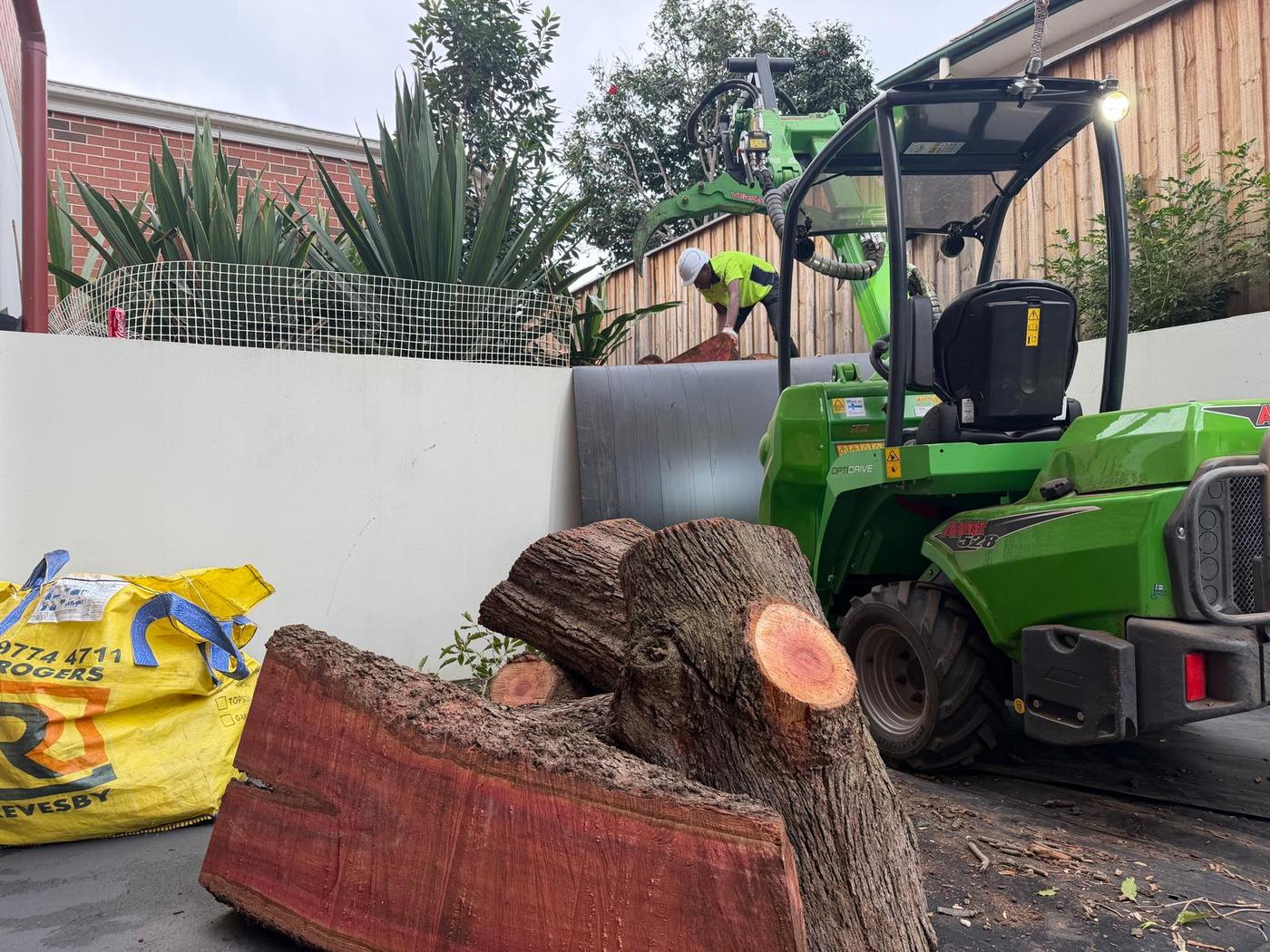
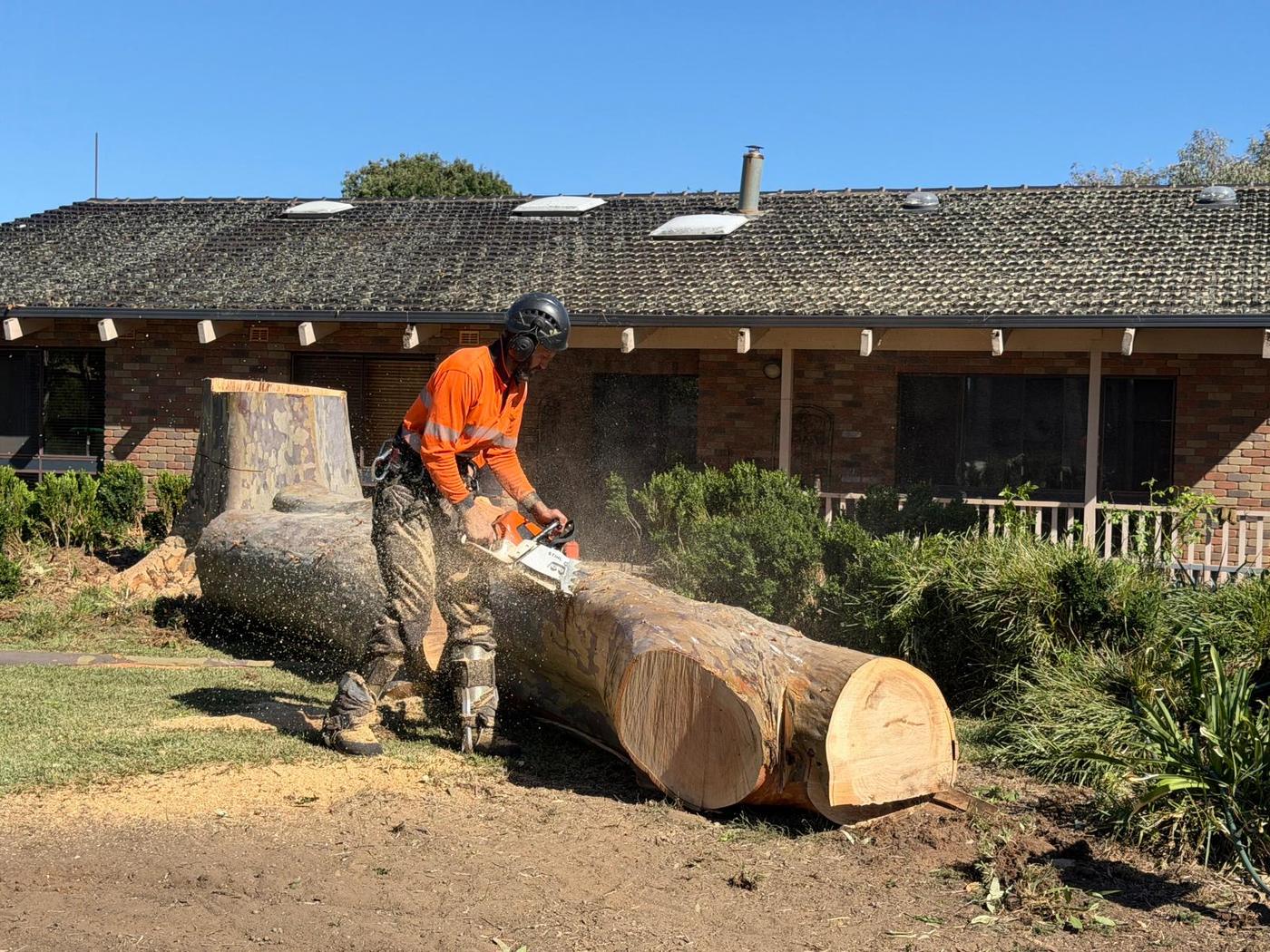
Our own crew, our own machinery, on Ku-ring-gai blocks.
Which trees are protected in Ku-ring-gai.
5 metres tall, or a 150 mm trunk
Ku-ring-gai defines a protected tree as a perennial plant with at least one self-supporting woody stem, native or exotic, that is 5 metres or more in height or has a trunk diameter of 150 mm or more measured at ground level. Either one triggers it — a short tree with a thick trunk is still protected.
Measured at ground level, not breast height
Worth noting, because most councils measure trunk diameter at 1.4 m. Ku-ring-gai measures at ground level, where the trunk is widest, so more trees are captured than owners expect.
Within 3 metres of the dwelling
Trees and vegetation within 3 m of an existing dwelling on the same property are exempt, measured from the centre of the trunk at ground level to the external wall. The exemption does not extend to verandahs, carports, detached garages or other ancillary buildings.
Tree application, or a DA
Ordinary pruning and removal go through a Tree Application. If the tree work is tied to a development, driveway or construction, it must go through the Development Application instead — the two are not interchangeable.
Minor pruning under 50 mm
Pruning branches no more than 50 mm in diameter is exempt. Anything thicker needs approval, whoever does the cutting.
Dead and dangerous trees still need approval
There is no automatic exemption. Council requires written notification and approval that the tree is dead or dying, or poses an imminent risk to life or property, before it comes down. In a genuine emergency call us and we make the site safe first.
Not sure if your tree is protected? Ask us before you apply.
Send the address and a photo. An AQF Level 5 arborist checks the species against the exemption list, measures it against the 5 m / 150 mm threshold and tells you honestly whether you need Council approval at all — at no charge, and before you pay for anything.
Get a free quote
Tell us what you need done and we will call you back to arrange a look. Every job is assessed individually - no two trees are the same.
Urgent or unsafe tree? Call 0422 023 242 - we answer 24 hours.
Trees you can remove without approval.
Ku-ring-gai’s DCP Part 13 lists species that can be removed without a Tree Application, mostly weeds and problem exotics. If your tree is on this list you do not need to apply — but check the species is right before anyone starts cutting, because getting it wrong is an offence.
Cocos Palm (Syagrus romanzoffiana) · Camphor Laurel is not on the list — do not assume · Liquidambar (Liquidambar styraciflua) only if under 12 m in height · Privet (Ligustrum spp.) · Rhus (Toxicodendron succedaneum) · Broad-leaf Pepper Tree (Schinus terebinthifolius) · Umbrella Tree (Schefflera actinophylla) · African Olive (Olea europaea subsp. cuspidata) · Coral Trees (Erythrina spp., including E. x sykesii) · Tree of Heaven (Ailanthus altissima) · Box Elder (Acer negundo) · Evergreen Alder (Alnus jorullensis) · Loquat (Eriobotrya japonica) · Rubber Tree (Ficus elastica) · Cotoneaster · Firethorn (Pyracantha spp.) · Nettle Tree (Celtis spp.) · Lombardy Poplar · Black Locust and Golden Robinia (Robinia pseudoacacia) · Queensland Silver Wattle (Acacia podalyriifolia) · Golden Wreath Wattle (Acacia saligna) · Crested Wattle (Paraserianthes lophantha).
The exemption applies to the species, not to the situation: a listed species inside a biodiversity-mapped area or an endangered ecological community can still be caught by other controls. Check the current list in Council’s DCP Part 13 before removing anything, or send us a photo and we will identify it.
The reasons Council accepts — and the ones it refuses every time.
Accepted: likelihood of failure
Where the tree is likely to fail and remedial work is not feasible. This is the ground that needs an arborist report with real evidence behind it, not an opinion.
Accepted: substantial structural damage
Substantial and continuing structural damage to a dwelling. Damage to paths and driveways is specifically excluded, which is where a lot of applications fall over.
Accepted: less than 5 years left
Where condition is poor enough that useful life expectancy is under five years. Again, this has to be demonstrated in a report.
Accepted: documented health impact
Where the tree is proven to be directly causing substantial ill health, supported by specialist medical evidence. Not a hay-fever letter.
Refused: leaves, flowers, sap and fruit
Leaf, flower, sap or fruit drop is not a ground for removal in Ku-ring-gai. Neither are blocked gutters caused by it.
Refused: shade, light and views
Shade, wanting more natural light, and improving a view are all explicitly rejected. So is “the tree is too large or too high” on its own.
Refused: damage to minor structures
Damage to fences, roof structures and outbuildings does not qualify, and neither does minor pipe damage where another remedy exists — which is often a root barrier rather than removal.
If it will be refused, we say so
If your reason is on the refusal list, we tell you before you pay for a report, and talk you through pruning, root management or a barrier instead. A refused application is a wasted month.
What Council charges to assess it.
Ku-ring-gai’s assessment fees are modest and are separate from the cost of the work: $88.00 to assess removal of one tree or hedge ($42.00 concession), $44.00 for pruning one tree or hedge ($20.00 concession), and $13.00 for each additional tree or hedge on the same application. Fees are set by Council and current at the time of writing — confirm on Council’s website before lodging.
The real cost is not the fee. It is the month you lose if the application comes back for more information, and the second report you then have to pay for. That is what a properly prepared application is worth.
Ku-ring-gai names the qualification. It is AQF Level 5.
Council’s own guidelines for arborist reports require the author to hold Australian Qualification Framework Level 5 (AQF5) in Horticulture (Arboriculture). A Certificate III arborist is a tree worker, not a consulting arboriculturist, and a report from one will not be accepted. True Roots reports are written by an AQF Level 5 consulting arborist — Diploma of Arboriculture, TAFE NSW — who is a registered consulting and practising member of Arboriculture Australia.
A scaled site plan
Trees, north point, services, buildings and structures drawn to scale — one of the most common reasons a report gets sent back.
A data table for every tree
Species, height, trunk diameter, canopy spread, health, structure, useful life expectancy and landscape significance, tree by tree.
Evidence, not assertion
Wounds, cavities, cracks, root zone condition, pests and disease, discussed and backed with photographs and any test results.
Testing done properly
Where decay testing is used, Council requires that sonic tomography be verified through resistograph testing — one instrument on its own is not enough.
Options, then a recommendation
All available options discussed on their merits, followed by a preferred recommendation with justification. A report that only argues for removal reads as advocacy.
Replacement planting and credentials
Proposed replacement planting and soil remediation, plus the arborist’s name, qualifications, experience and any pecuniary interest disclosed.
One thing to be aware of: where the application relies on a formal tree risk assessment, Council requires an industry-recognised methodology — TRAQ or QTRA — with the completed assessment sheets and a current accreditation certificate attached. If your matter needs that specific format, tell us up front and we will confirm how it is best handled before you commit. Most Ku-ring-gai applications do not require it; they turn on condition, structure and useful life expectancy, which is the standard AQF Level 5 assessment.
Our reports run $1,500–$2,000 ex GST for most jobs. See arborist reports for what is included.
Why Ku-ring-gai is stricter than the councils south of the Harbour.
Ku-ring-gai sits on shale-capped ridges that carry three listed ecological communities. Blue Gum High Forest is critically endangered at both State and Commonwealth level, with less than five per cent of its original extent remaining — the best surviving stands are around Dalrymple-Hay Nature Reserve and Browns Forest at St Ives, and its Sydney Blue Gums reach 30 metres. Sydney Turpentine-Ironbark Forest and Duffys Forest are also listed. Clearing native vegetation in a threatened ecological community or on biodiversity-mapped land is not something a Tree Application can authorise on its own.
This is why removals here need more evidence than in most LGAs, why replacement planting is routinely conditioned — Council looks for a net gain of canopy area on maturity, using species from the relevant ecological community — and why a Blackbutt or Blue Gum in a Wahroonga or St Ives backyard is treated very differently to the same tree elsewhere in Sydney. It is also why the work itself needs a crew that can dismantle a 30 m tree over a house rather than fell it.
Four steps from photo to approved work.
Send the address and a photo
We check the species against the exemption list, the size against the 5 m / 150 mm threshold, and whether the site is in a biodiversity or heritage overlay.
We tell you honestly what applies
Exempt, Tree Application, or a DA — and whether your reason is one Council accepts. If it will be refused, you hear that first.
Report and lodgement
Where a report is needed, an AQF Level 5 arborist inspects, measures and photographs, writes it to Council’s guidelines, and we lodge the application for you.
The work, then the clean-up
Once approved, our own crew and machinery do the job, meet any replacement planting condition, and leave the site clean.
Where we work in Ku-ring-gai.
Wahroonga, Warrawee, Turramurra, South Turramurra, North Turramurra, Pymble, West Pymble, Gordon, Killara, East Killara, Lindfield, East Lindfield, Roseville, Roseville Chase, St Ives, St Ives Chase and Wahroonga’s bushland fringe. We are based in Mortdale and run crews north daily.
Ku-ring-gai tree rules, answered plainly.
Do I need council approval to remove a tree in Ku-ring-gai?
Yes, if the tree is 5 metres or more in height or has a trunk diameter of 150 mm or more measured at ground level. Either threshold on its own makes the tree protected. There are two main exceptions: the tree is on Council’s exempt species list, or it is within 3 metres of an existing dwelling on the same property, measured from the centre of the trunk at ground level to the external wall.
How much does a Ku-ring-gai tree application cost?
Council’s assessment fee is $88.00 to remove one tree or hedge, $44.00 to prune one, and $13.00 for each additional tree on the same application. Concession rates are $42.00 and $20.00. Where an arborist report is required, True Roots reports are $1,500–$2,000 ex GST. The tree work itself is quoted separately.
Can I remove a Cocos palm in Ku-ring-gai without approval?
Cocos Palm (Syagrus romanzoffiana) is on Ku-ring-gai’s exempt species list, so it can generally be removed without a Tree Application. Liquidambar is also exempt, but only where it is under 12 metres in height. Confirm the species and the current list before removing anything — removing a protected tree by mistake is an offence.
My tree drops leaves in the pool and blocks the gutters. Will Council approve removal?
No. Ku-ring-gai’s assessment guidelines specifically exclude leaf, flower, sap and fruit drop as a ground for removal, along with shade, wanting more natural light, improving a view, and the tree simply being large. Applications on those grounds are refused. Selective pruning to AS 4373 is usually the realistic answer, and we will tell you that rather than sell you a report.
What qualification does the arborist need for a Ku-ring-gai report?
Council’s report guidelines require Australian Qualification Framework Level 5 (AQF5) in Horticulture (Arboriculture). Certificate III holders are classified as tree workers, not consulting arboriculturists, and their reports are not accepted. True Roots reports are written by an AQF Level 5 consulting arborist who is a registered consulting and practising member of Arboriculture Australia.
The tree is dead or dangerous. Can I take it down straight away?
Not without Council’s written agreement. Ku-ring-gai requires notification and approval that the tree is dead or dying, or poses an imminent risk to life or property, before removal. If there is an immediate danger — a failed limb over a driveway, a split trunk after a storm — call us and we make the site safe, then document what was done for Council. See emergency tree removal.
What is Blue Gum High Forest and does it affect my block?
Blue Gum High Forest is a critically endangered ecological community on the shale ridges through Ku-ring-gai, with less than five per cent of its original extent left. If your block carries remnant canopy, or sits on biodiversity-mapped land, the tree controls are tighter and clearing may need more than a Tree Application. Send us the address and we will check what applies before you lodge anything.
Will I have to plant a replacement tree?
Usually, yes. Ku-ring-gai routinely conditions approvals on replacement planting aimed at a net gain of canopy area on maturity, using species from the relevant ecological community. We include a replacement planting schedule in the report so the condition is answered before it is raised, and we can supply and plant the trees. See advanced tree planting.
Where these rules come from.
Everything on this page is taken from Ku-ring-gai Council’s own published documents: the Trees on your property page, Ku-ring-gai DCP Part 13 (Tree and Vegetation Preservation), Council’s tree assessment guidelines, and Council’s guidelines for the preparation of arborist reports. Tree work in NSW also sits under the State Environmental Planning Policy (Biodiversity and Conservation) 2021. Rules and fees change — check Council’s website before you lodge, or ask us and we will check it for your address.
Qualified, insured and accountable
- AQF Level 5 arboristDiploma of Arboriculture (TAFE NSW). Reports accepted by Sydney councils.
- ISO 9001 certifiedQuality management system, audited. SWMS and risk assessments with every quote.
- $20M public liabilityPlus icare workers compensation. Certificates of currency sent on request.
- Australian StandardsPruning to AS 4373, tree protection on building sites to AS 4970.
- Indigenous-ownedTender-ready for councils, strata and builders: certificates of currency and site documentation supplied with every quote.
- 5.0 on Google66 reviews, every one from a real job. Read them.


Send the address. We will tell you what Ku-ring-gai requires.
An AQF Level 5 consulting arborist checks the species, the threshold and the overlays, tells you honestly whether you need approval, prepares the report and application if you do, and can carry out the work once it is approved.