
Mortdale based. Sydney wide. 15 years on the tools.
Tree Removal in Sydney: Rules, Process and Costs (2026 Guide)
AQF Level 5 arborists, $20M public liability and council paperwork handled. Tell us about the job and we call you back the same day.
★ 5.0 from 71 Google reviewsAQF Level 5 arboristsISO 9001 certified$20M public liability
Everything the council, the law and the quote will ask you about a tree in Sydney — in one place, with the sources.
Most of what is written online about removing a tree in Sydney is either a council page that stops at “you may need a permit” or a price site that never names the law. This guide does the whole chain: the State policy that protects trees, the council rules that set the thresholds, the exemptions people get wrong, the fines that are actually issued, the step-by-step process, what it costs in 2026 and what a legitimate contractor has to do on the day under the new SafeWork code. Every claim links to its source.
Quick answer
You need council approval to remove a tree in Sydney if it is above your council’s size threshold and no exemption applies. The thresholds are set by each council, not by the State, and range from 3 m (Georges River, Waverley, Parramatta) to 5 m (Ku-ring-gai, Randwick and others). Exemptions exist for exempt species, trees very close to the house in some councils, dead branches, minor pruning and bushfire 10/50 work — but a dead tree is not automatically exempt, and nothing is exempt on a heritage item or in a critically endangered forest community. The fine for getting it wrong starts at $3,000 on the spot and has reached $36,000 in a local court this year.
The law in plain English
State level: SEPP (Biodiversity and Conservation) 2021, Chapter 2
Chapter 2 “sets the rules for clearing trees and other vegetation in urban, environmental and conservation areas of NSW”. It applies in the listed Sydney local government areas and in residential, employment, mixed-use, recreation, special-purpose and conservation zones. Under it, you need a permit from your council to clear vegetation that is protected by the council’s development control plan, and “clearing” is broad: it “includes cutting down, felling, uprooting, poisoning, ringbarking, burning” and “lopping or removing a substantial part of the vegetation”. Large-scale clearing that triggers the Biodiversity Offsets Scheme thresholds goes to the Native Vegetation Panel instead of the council.
Council level: the DCP sets the thresholds
The State policy says “Council development control plans (DCPs) identify which trees and vegetation on private land require approval before removal”. That is why the rules change at the council boundary: Ku-ring-gai protects a tree at 5 m or a 150 mm trunk, Georges River at 3 m or 100 mm, Willoughby at 4 m or a 600 mm girth. The council-by-council table below has each one with its source.
Permit, development application or Native Vegetation Panel
Three routes. A tree permit (sometimes called a tree application or TPO application) covers an ordinary protected tree on private land. A development application is needed where the tree is part of a heritage item, inside a heritage conservation area, on a council’s significant tree register, or on land mapped as a threatened ecological community — the usual DCP exemptions do not apply there. The Native Vegetation Panel deals with clearing above the Biodiversity Offsets Scheme thresholds that is not part of a development; a homeowner removing a tree will not meet it.
The safety exemption has a catch
Every council exempts a tree that is an imminent danger, but the State policy is explicit: “Your council must confirm in writing that the exemption applies before you start any clearing work”. A storm-damaged limb hanging over the house can be made safe; the rest of the tree waits for the letter, or for an AQF Level 5 arborist’s certificate where the council accepts one.
Exemptions — and where people get them wrong
Dead, dying or dangerous
Not automatic. Ku-ring-gai says no work until Council confirms in writing the tree is dead and is not habitat; Inner West says removal of dead trees requires consent; Northern Beaches accepts a Level 5 arborist’s certificate for a dangerous tree. Get the paper first.
Distance from the house
There is no Sydney-wide “3 metre rule”. Canterbury-Bankstown and Ku-ring-gai exempt trees within 3 m of a wall of the dwelling; Northern Beaches uses 2 m from an approved building; Inner West 1 m; Georges River has no distance exemption at all. Verandahs, carports and garages never count.
Exempt and weed species
Each council keeps a list, and the lists differ: cocos palm is exempt almost everywhere, camphor laurel only under 6 m in Georges River and 10 m in Canterbury-Bankstown, privet and African olive widely. See our cocos palm and camphor laurel pages for the per-council wording.
10/50 bushfire clearing
In a designated entitlement area you may clear trees within 10 m of a home and underlying vegetation within 50 m, measured “from the external walls of the building”, including attached decks, verandahs and garages but not detached sheds or garages. The RFS says to check its online tool on the day. It does not apply on slopes over 18 degrees (without a geotechnical report), within 10 m of a lake or river 2 m or more wide, where heritage or threatened species are mapped, without the landowner’s approval, or to clearing around powerlines.
Minor pruning
Deadwood is exempt nearly everywhere. Live pruning without a permit is capped by council: 10% of the canopy a year in Hornsby and Inner West, 10% in 12 months in Sutherland Shire, 50 mm branches in Ku-ring-gai, deadwood only in Georges River. Our pruning page has the table with sources.
Heritage and endangered forest
Inside a heritage conservation area, on a heritage item, or on land mapped as Blue Gum High Forest or Sydney Turpentine-Ironbark Forest, the exemptions above are switched off and the job is a development application. Common on the North Shore and Inner West.
Council by council: thresholds, fees and timeframes
From each council’s own page or policy, read in October 2026. “Not published” means the council does not state it online, not that there is none. Fees change every July.
| Council | Protected tree threshold | Application fee | Published timeframe | Our guide |
|---|---|---|---|---|
| Georges River | Height 3 m+, trunk 100 mm+ at ground, or 3 m spread (Tree Management Policy 2024); deadwood-only pruning exempt | Application fee per Fees and Charges | Council aims to issue a permit within 18 weeks | Georges River guide |
| Sutherland Shire | Trunk over 100 mm at 500 mm; branches over the roof and minor pruning (10%, once a calendar year) exempt (DCP Ch 39); within 3 m of the house still needs an application | $164 removal; pruning-only applications free | Not published | Sutherland guide |
| Bayside | Permit unless under 3 m high and 300 mm wide at 1.4 m, fruit tree or exempt species | $125.50 (1–3 trees), $254 (4–10), $412 plus quoted cost (over 10) — 2026–27 | Not published | Bayside guide |
| Canterbury-Bankstown | Trees 5 m+; within 3 m of a wall of the primary dwelling exempt | Per Fees and Charges (banded by number of trees) | Not published | Council guides |
| Inner West | DCP-protected; within 1 m of a dwelling exempt; dead trees still need consent | Not published on the FAQ | Not published | Council guides |
| City of Sydney | DCP-protected; Register of Significant Trees needs consent at any size | $98 | 28 days | Council guides |
| Ku-ring-gai | 5 m+ or trunk 150 mm+ at ground; dead trees not automatically exempt | $88 removal, $44 pruning, $13 each extra | Not published | Ku-ring-gai guide |
| Hornsby | DCP-protected; up to 10% canopy once a year exempt | $224 (1–3 trees), $279 (4–9) — 2026–27 | Minimum 28 days | Council guides |
| North Sydney | Over 5 m high, crown over 5 m or trunk girth over 500 mm at ground; camphor and Celtis over 10 m | $90 | 12 business days | Council guides |
| Willoughby | Over 4 m, girth over 600 mm at 1.4 m, or crown over 3 m; 10% over 5 years | Fees apply | Not published | Council guides |
| Northern Beaches | Under 5 m exempt; within 2 m of an approved building exempt; dangerous = Level 5 arborist certificate | Not published | Permit valid 12 months | Council guides |
| Randwick | 5 m+ high, 4 m+ canopy or 1 m+ circumference at 1 m; any palm except cocos | Not published | About 4 weeks, longer if neighbours are notified | Council guides |
| Woollahra | Over 5 m or crown over 3 m | Not published | Not published | Council guides |
| Waverley | 3 m+ high or canopy, or on the Significant Tree Register | $134.02 first tree, $46 each additional | About 4 weeks (6–8 with notification) | Council guides |
| Parramatta | Under 3 m exempt (outside Biodiversity-mapped land); dead/dying with evidence; imminent risk may need an AQF5 assessment | $151 first tree, $128 each additional | Not published | Council guides |
Few Sydney councils publish a processing time: City of Sydney (28 days), Hornsby (minimum 28 days), North Sydney (12 business days), Waverley and Randwick (about four weeks, longer with neighbour notification) and Georges River (which aims for 18 weeks). For the rest, plan on a month or more and lodge a complete application — photos, site plan, owner’s consent — because an incomplete one goes to the back of the queue.
Fines and prosecutions
The maximums
Removing a protected tree without consent is development without consent under the Environmental Planning and Assessment Act 1979. The Judicial Commission’s Local Court Bench Book sets out the tiers (sections 9.52–9.54): Tier 1 — $5 million for a corporation and $1 million for an individual, plus daily penalties; Tier 2 — $2 million and $500,000; Tier 3 — $1 million and $250,000. A Local Court can impose up to $110,000; the bigger numbers come from the Land and Environment Court.
What is actually issued
On-the-spot penalty notices of $3,000 for an individual and $6,000 for a company are the everyday tool. Then the prosecutions:
- Killara, 2026 — $10,000 fine plus $4,800 costs at Hornsby Local Court for removing a 24 m Norfolk Island pine without consent.
- Padstow Heights, 2025 — $36,000 at Bankstown Local Court for removing a weeping lilly pilly, two evergreens and a magnolia and pruning a eucalypt without consent, after six penalty notices had already been issued.
- Epping, 2021 — City of Parramatta Council v Grand Epping Pty Ltd [2021] NSWLEC 70 and v Sydney Trees Excavation and Demolition Pty Ltd [2021] NSWLEC 71: $100,000 for the developer and $55,000 for the tree contractor for 21 trees cleared in a heritage conservation area, with replacement planting ordered.
The Epping case is the one to show any contractor who says the permit is your problem. It is theirs too.
The removal process, step by step
1. Measure and map
Height, trunk diameter at the council’s stated point, distance to the house, species, heritage and biodiversity mapping. This decides exempt, permit or DA before anyone touches a form.
2. Arborist report where it counts
Not every application needs one — Ku-ring-gai says so outright — but a contested, heritage or large tree is decided on the evidence. Councils specify AQF Level 5, AS 4970 and a recognised risk method. Ours are $1,500–$2,000. See arborist reports.
3. Lodge, complete
Photos, a site plan, the reason council accepts (failure risk, decline, structural damage — not views, leaf drop or “too big”), owner’s consent and the fee. We lodge for clients.
4. Inspection and decision
Council inspects, then approves with conditions, approves pruning instead, or refuses. Replacement planting is a standard condition; most councils aim for a net gain in canopy.
5. Before You Dig for the stump
Stump grinding is excavation. Lodge a free Before You Dig Australia request at least one day before, and report any damage to the asset owner immediately.
6. The job, under the 2026 code
Dismantled in sections or craned, drop zone set by risk assessment, two-rope climbing, licensed EWP operator, traffic control if the street is used. Then the stump, the clean-up and the replacement tree.
What tree removal costs in Sydney in 2026
Our own prices, ex GST, one fixed price after we have seen the tree:
| Job | Price | What moves it |
|---|---|---|
| Small tree or palm removal (under 5 m) | $300–$900 | Front-yard access is the cheap end; rear access or a stump adds to it |
| Medium tree removal (5–10 m) with stump ground | $1,500–$4,000 | Sectional dismantle near a driveway, boundary or pool, waste removed |
| Large or hazardous tree removal (10 m+) | $5,000–$25,000+ | Rigging or crane over the house, two to three days, traffic control where needed |
| Pruning, crown reduction, deadwood (AS 4373) | $800–$4,000 | Size, how much comes off, powerlines, access |
| Stump grinding (per stump) | $300–$900 | Diameter, depth, access; tight-access grinder for side passages |
| AQF Level 5 arborist report for council | $1,500–$2,000 | AS 4970 impact assessments quoted per site |
| Land clearing and vegetation removal | $6,000–$25,000 | Whole blocks, bushfire zones, invasive species; mulch left on site is free |
More than one tree, an arborist impact assessment for a development, or a council application add to the total. Council fees are shown separately.
Why the online “arborist report” prices are misleading
Cost aggregators quote reports at a few hundred dollars. A report a Sydney council will accept for a contested tree is written by an AQF Level 5 arborist to the council’s own guidelines, with a site visit, a recognised risk assessment, AS 4970 root-zone calculations and, where decay is suspected, instrument testing. That is a day’s work and it is the difference between approved and refused — a refused application costs you the fee, a month, and often a second report anyway.
What drives a quote up
Access (a tree that cannot be felled and has to be climbed and lowered in pieces), what is underneath it (pools, glass, neighbours’ roofs), powerlines, the need for a crane and traffic control, the size of the stump, and distance from our Mortdale yard. Our cost guide works through examples.
Safety: what a legitimate contractor must do
On 27 March 2026 SafeWork NSW’s Tree Works Code of Practice commenced, replacing the 1998 amenity-tree code. It is approved under the Work Health and Safety Act and it tells you what to look for when you hire:
- Two points of attachment for climbers — the code says “two points of attachment should be used, preferably from independent anchor points” and that cutting starts only when the climber is secured by both.
- A drop zone and an exclusion zone set by a risk assessment, with ropes kept clear of the chipper and stump grinder.
- Licensed EWP operators — “Where the boom length of the EWP is 11 metres or more, operators must hold a high risk work licence”.
- A rescue plan, a worker holding the national aerial rescue qualification, and no one working alone.
- Traffic control by licensed, competent workers whenever the job uses the road.
- Insurance you can read: public liability and workers compensation certificates in the company’s name. Ours are $20M public liability and icare workers comp, sent with every quote.
- Powerlines: work near the street lines is for the network’s authorised contractors; the private service line to your house is yours, and ours to do with authorised crews.
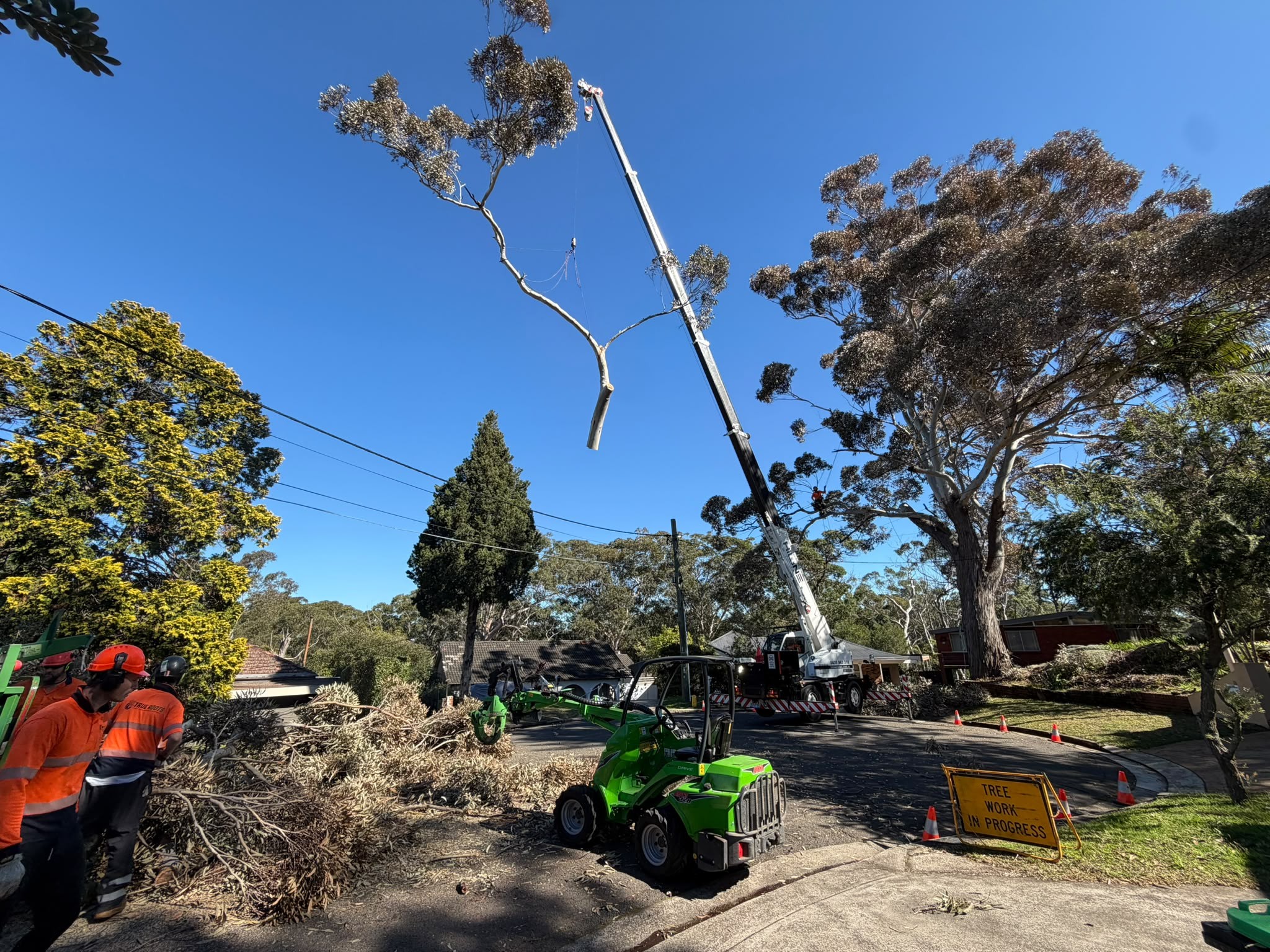
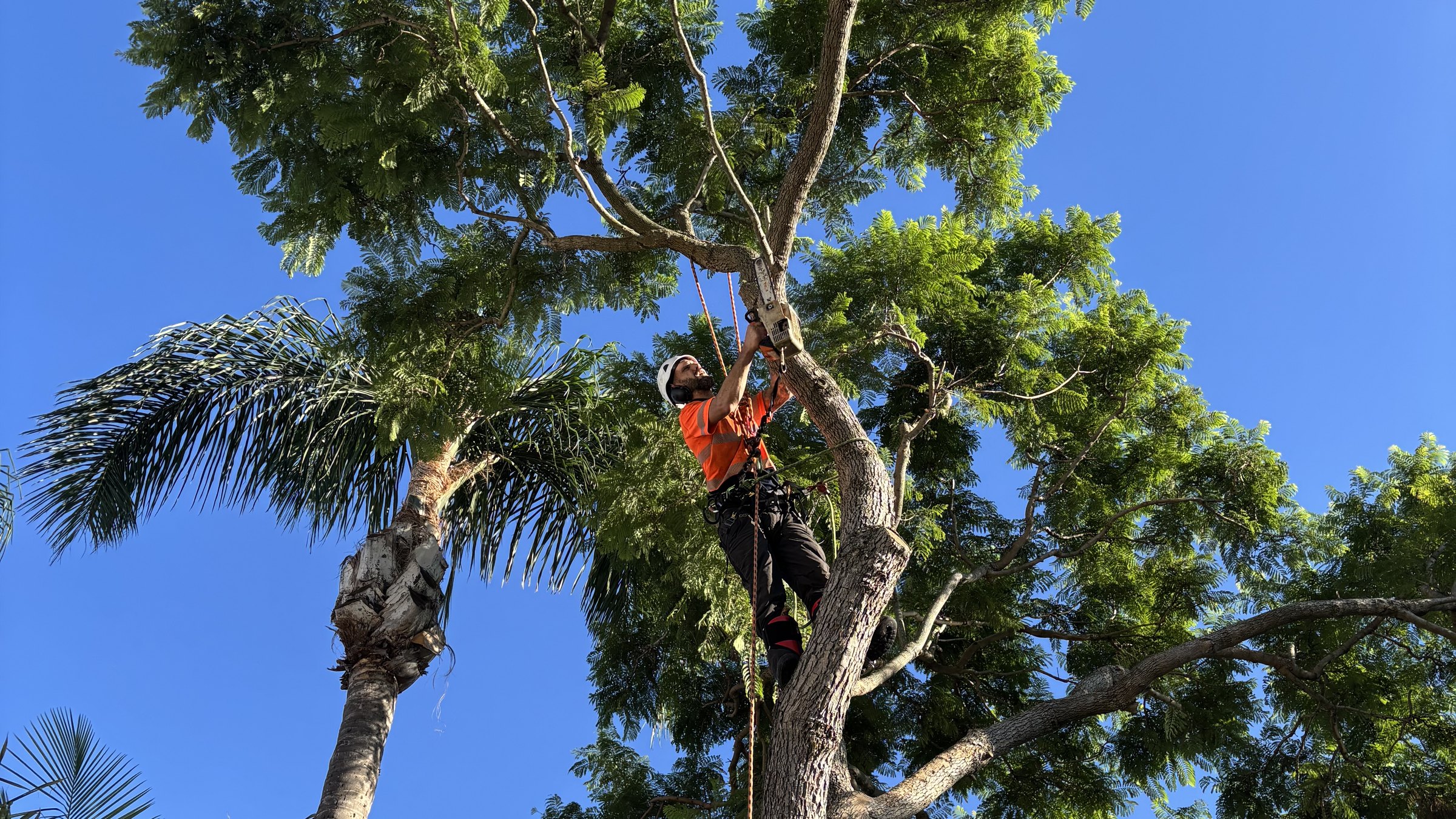
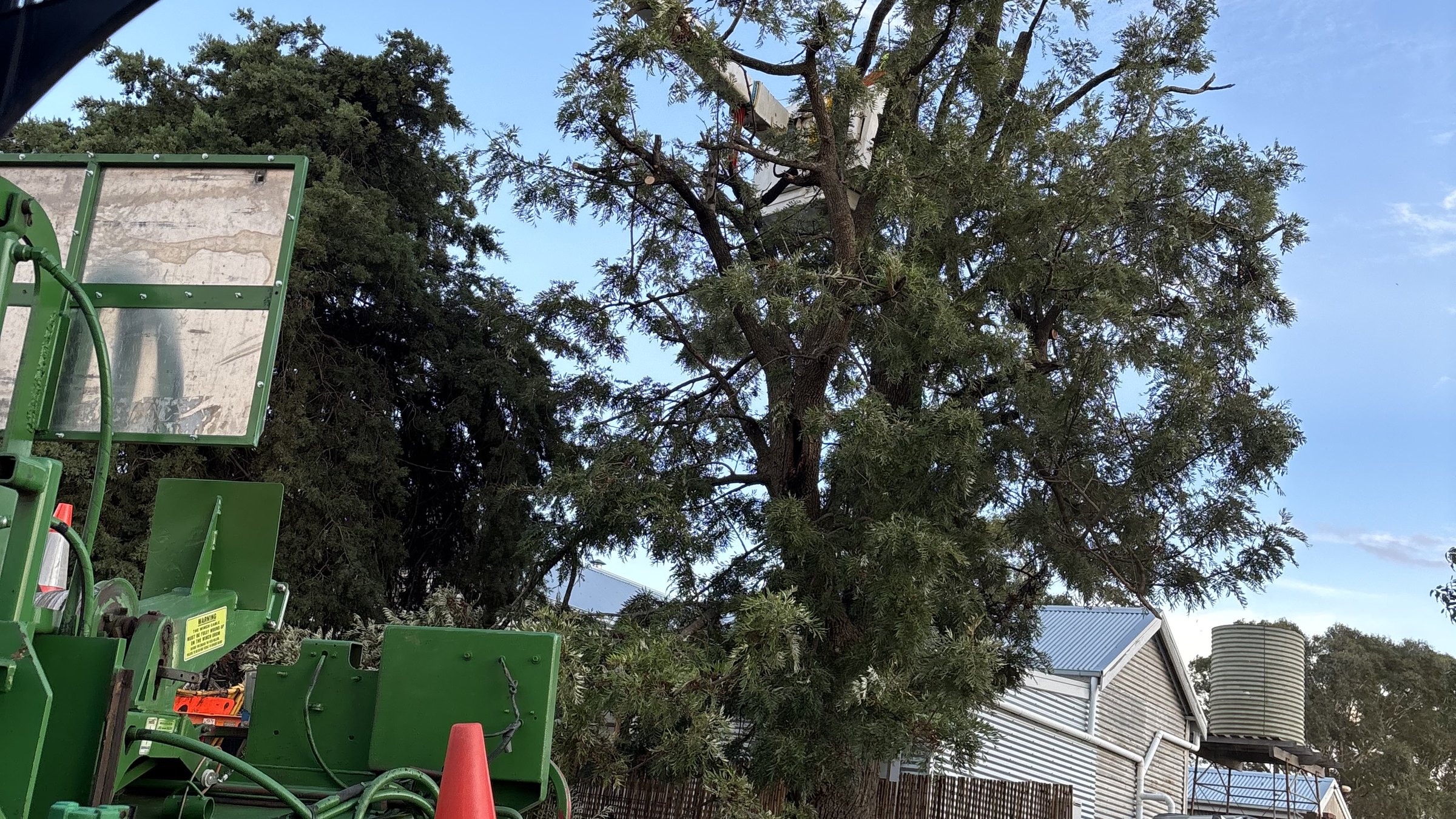

Photos from our own jobs. Client addresses are never published.
Neighbours’ trees
You can generally cut back branches and roots to your boundary at your own cost, within the same council rules that apply to your own trees, and without harming the tree. Beyond that, the Trees (Disputes Between Neighbours) Act 2006 lets you apply to the Land and Environment Court for orders to have a neighbour’s tree pruned or removed, or for compensation for damage it has caused; hedges that block sunlight or views are covered separately, without compensation. The Court must be satisfied you tried to resolve it first, and costs are generally not awarded. Our neighbour tree rights guide goes through it.
Questions people ask
Do I need council approval to remove a tree on my property in Sydney?
If the tree is over your council’s size threshold and no exemption applies, yes. Thresholds run from 3 m (Georges River, Waverley) to 5 m (Ku-ring-gai and most others). The table above lists each council with its source.
What size tree can I remove without council approval in NSW?
It depends entirely on the council: under 3 m in Georges River and Parramatta, under 5 m in Ku-ring-gai, Northern Beaches and Randwick, under 4 m in Willoughby. Trunk and crown measurements also count in several councils.
Can I remove a dead tree without a permit?
Usually not without the council’s written confirmation that it is dead and not habitat. Inner West and Ku-ring-gai say so explicitly; the State policy requires written confirmation of any safety exemption before clearing starts.
What is the fine for cutting down a tree in NSW?
On-the-spot penalty notices are $3,000 for an individual and $6,000 for a company. Courts have fined $10,000 (Killara, 2026), $36,000 (Padstow Heights, 2025) and $155,000 across a developer and contractor (Epping, Land and Environment Court, 2021). The statutory maximums run to $5 million.
How long does a tree removal permit take?
City of Sydney says 28 days, Hornsby a minimum of 28 days, North Sydney 12 business days, Waverley and Randwick about four weeks, Georges River aims for 18 weeks. Most councils publish nothing; plan on a month or more and lodge a complete application.
Do I need an arborist report to remove a tree?
Not always — Ku-ring-gai states one is not required to apply. For a large, heritage or contested tree the decision rests on the report, and councils require AQF Level 5. A proper one is $1,500–$2,000.
Is tree lopping illegal in NSW?
Lopping an unprotected tree on your own land is not an offence; lopping a protected one without a permit is unauthorised clearing. Councils will not approve lopping because the Australian Standard calls it an unacceptable practice — see tree lopping done properly.
Does stump grinding need a permit or a Before You Dig check?
No permit for a stump left after a lawful removal, but it is excavation: lodge a free Before You Dig Australia request at least one day before. See stump removal.
Who is responsible for trees near powerlines?
The network (Ausgrid or Endeavour) and its authorised contractors for the street lines; the property owner for the private service line to the house, which must be cleared by authorised crews.
Can my neighbour force me to remove my tree?
Only through the Land and Environment Court under the Trees (Disputes Between Neighbours) Act 2006, and only if the tree has caused, is causing or is likely to cause damage or injury. Hedges blocking views are a separate, narrower category.
What our clients say
Real reviews from Sydney clients, quoted from our Google profile. Long reviews are shortened; tap Read more for the full review on Google.
 Reviews
…Really great service, professional, safe and accommodating. Difficulties of access easily overcome, good people to deal withRead more
 David G.October 2026
Jimmy and the guys were excellent at their job—very fast and very tidy. I highly recommend them, and I certainly wouldn't hesitate to use them again in the future. "True Roots" are the best.
Nomikos R.October 2026Removed 4 bunches of palm nuts and tidied everything up. Great job.
Matthew K.October 2026Jimmy and his crew were fast, efficient and professional! He was so helpful in removing a tree in our yard that was a safety hazard. I highly recommend True Roots and would not hesitate to use them again if needed.
Liz B.June 2026Jimmy and his team were excellent. Fast, reliable, well-priced and impressive work. Great to see such a good, local tree removal business and arborist in Mortdale and operating in the St George area. You will not be disappointed using these guys.
Jamie D.April 2026Great service! I liked how they cleaned up after they chopped down our tree. Efficient and very competitive pricing. I would happily book them again in the future.
Celia L.April 2026Jimmy and the two men working with him were professional, hard working and efficient with their time. They removed a large bougainvillea adjacent to the pool. I was very impressed with how well they did this, especially given how thorny it…Read more
Jan B.March 2026I recently hired True Roots to remove a large gum tree from my property, and I couldn’t be more impressed with their service. From the initial consultation to the final clean-up, the team of arborists were professional, efficient, and…Read more
Joseph2025Jimmy was amazing; right from the beginning, he was informative, professional and willing to work within our budget. We could not be happier with what he has delivered for us. We removed all our side trees and replaced them with hedges and…Read more
JJ2025Highly recommend the Team from True Roots, the boys came in and removed a Black Butt that was overhanging our house. Very competitive pricing and managed to squeeze us in. The stump was ground back and all waste was removed. Very professional and skilled workers. Will definitely use them again in the future.
Ben G.2024Highly recommend! James and the boys did an amazing job cutting down a large tree in my yard. Super professional, efficient, and left everything clean and tidy. Great service, and I’m really happy with the results. Will definitely call again for any future tree work! Thanks Andrew
Andrew M.2024Qualified, insured and accountable
- AQF Level 5 arboristDiploma of Arboriculture (AHC50524), TAFE NSW, 2024. About 15 years in arboriculture.
- ISO 9001 certifiedQuality management system certified to ISO 9001.
- $20M public liabilityPlus icare workers compensation. Certificates of currency sent with every quote.
- Australian StandardsTree pruning and trimming to AS 4373, tree protection on building sites to AS 4970.
- Indigenous-ownedOwned and operated by an Indigenous director. Registered NSW Government supplier on buy.nsw.
- 5.0 on Google71 reviews, every one from a real job. Read them.


A tree you need a straight answer on?
Send a photo and your suburb. We tell you exempt, permit or DA, lodge it if needed, and give you one fixed price.
Get a free quote
Tell us what you need done and we will call you back to arrange a look. Every job is assessed individually - no two trees are the same.
Urgent or unsafe tree? Call 0422 023 242 - we answer 24 hours.