
Tree protection zones for builders, developers and owners.
Tree Protection Zones & Tree Protection Plans Sydney
AS 4970 tree protection plans, a named AQF Level 5 project arborist, TPZ fencing, root pruning and root barriers, then the compliance certificate at the end. One quote covers the plan, fencing, root work and inspections.
★ 5.0 from 71 Google reviewsAQF Level 5 arboristsISO 9001 certified$20M public liability
What is a tree protection zone (TPZ)?
TPZ stands for tree protection zone. It is the area around a retained tree that is fenced off and protected during building work, so nothing is dug, filled, stored or driven over the roots without the project arborist involved. Under AS 4970:2025 the calculated root area is called the nominal root zone (NRZ), and TPZ now refers to the protection set out on site: fencing, trunk and ground protection.
Most builders meet a TPZ as a condition of consent, often worded like this: “Tree protection measures in accordance with AS 4970-2009 shall be installed prior to any works and inspected by the project arborist.” That sentence means fencing before the excavator arrives, an arborist on call for any trench that crosses the zone, and a folder of inspection reports for the occupation certificate. We do all of it. Because we are also a tree removal and landscape construction company, we already understand the site, the machinery and the program.
For homeowners the same rules apply to a pool, a granny flat, a new driveway or a retaining wall near a protected tree or a neighbour’s tree. The cheapest time to talk to us is before the plans are lodged, when moving a footing half a metre still costs nothing.
Tree protection services we provide
Tree protection plans
NRZ, TPZ and SRZ for every retained tree, drawn over the site plan, with fencing lines, ground protection, no-go areas and the inspection schedule your consent asks for. Written to AS 4970:2025, or the edition your consent names.
Project arborist
An AQF Level 5 arborist named on the consent as the project arborist: pre-construction inspection, hold-point inspections during works, incident reports if something goes wrong, and a final compliance certificate.
Encroachment assessments
When a footing, driveway or service trench has to cross the zone, we measure the encroachment, set out how the tree can still be retained and give the certifier the justification in writing.
Root mapping and root pruning
Roots exposed by hand and air spade before excavation, then the roots that have to go are cut cleanly by the arborist instead of being torn out by the bucket.
Root barriers and ground protection
Root barrier to protect slabs, pipes and pools from the retained tree, and rumble boards, mulch and steel plate where machinery has to cross the zone. See root barrier installation.
Fencing, signage and supervision
TPZ fencing and signs installed before demolition, moved only with the arborist’s written approval, and supervision for any work that has to happen inside the zone.
AS 4970:2025 and AS 4970-2009: what changed
AS 4970 Protection of trees on development sites was updated in 2025 and the 2009 edition was superseded. The way the root area is calculated did not change, but the names did, and the encroachment rules now allow more where it is justified.
| Item | AS 4970-2009 | AS 4970:2025 |
|---|---|---|
| Calculated root area | Tree protection zone (TPZ) | Nominal root zone (NRZ) |
| TPZ means | The calculated zone | The above-ground protection set out on site: fencing, trunk and ground protection |
| Trunk measurement | DBH, diameter at breast height (1.4 m) | DSH, diameter at standard height (1.4 m) |
| Calculation | 12 x DBH, 2 m to 15 m radius | Same calculation as before |
| Encroachment | Up to 10% minor with little justification | Moderate up to 20%; 20 to 30% with root mapping and tree-sensitive design |
Many consents and council manuals still name the 2009 edition, including the City of Ryde, Georges River and Ku-ring-gai documents we have read. Work to the edition your conditions name. Sources: Sparke Helmore on AS 4970:2025, 2025 tree protection specification prepared for the City of Parramatta (Civic Link), Standards Australia AS 4970:2025.
How to calculate a tree protection zone and SRZ
The formulas
- Root zone radius = trunk diameter at 1.4 m (metres) x 12. Never less than 2 m, never more than 15 m.
- Root zone area = 3.14 x radius x radius. This is the area encroachment percentages are measured against.
- SRZ radius = (D x 50)0.42 x 0.64, where D is the trunk diameter in metres just above the root buttress. Trees under 0.15 m have an SRZ of 1.5 m.
Worked example
A gum 50 cm across at 1.4 m and 60 cm above the buttress:
- Root zone radius: 0.5 x 12 = 6.0 m
- Root zone area: about 113 m², so 10% is about 11.3 m² and 20% is about 22.6 m²
- SRZ radius: (0.6 x 50)0.42 x 0.64 = about 2.7 m
TPZ and SRZ calculator
- Root zone radius
- 6.0 m
- Root zone area
- 113 m²
- 10% / 20% of the area
- 11.3 m² / 22.6 m²
- SRZ radius
- 2.7 m
An estimate from the published formulas. The project arborist measures each tree on site, and your consent conditions decide.
TPZ radius by trunk diameter — quick lookup
Both editions of AS 4970 size the calculated root zone at 12 times the trunk diameter at 1.4 m, with a 2 m minimum radius and a 15 m maximum:
| Trunk diameter at 1.4 m | Radius from the trunk centre |
|---|---|
| Under 17 cm | 2 m minimum applies |
| 20 cm | 2.4 m |
| 30 cm | 3.6 m |
| 40 cm | 4.8 m |
| 50 cm | 6 m |
| 60 cm | 7.2 m |
| 80 cm | 9.6 m |
| 100 cm | 12 m |
| 125 cm and over | Capped at 15 m |
Multi-stem trees and the structural root zone (SRZ) are worked out differently — that is part of what the project arborist calculates on site.
How much encroachment is allowed in a tree protection zone?
| Encroachment into the root zone | How it is treated |
|---|---|
| Up to 10%, outside the SRZ | Minor. The project arborist confirms it. |
| 10% to 20%, outside the SRZ | Moderate. AS 4970:2025 provides for encroachment up to 20%. Councils still working to the 2009 edition may treat anything over 10% as major: the City of Ryde manual does, and asks for the lost area to be made up elsewhere around the tree. |
| 20% to 30% | Major. Needs root mapping and a tree-sensitive design, such as pier-and-beam footings, a suspended slab or moved services. |
| Over 30%, or any work in the SRZ | Needs specific justification from the project arborist, and often a design change. |
Our arboricultural impact assessment page shows how an encroachment is assessed for a development application.
TPZ fencing and signage requirements
Your consent and your council’s own specification come first. As an example of what Sydney councils ask for, the City of Ryde Tree Management Technical Manual sets out:
- 1.8 m high, fully supported chain-mesh fencing, secured so it cannot be shifted, with a lockable opening
- Fencing moved only with the project arborist’s approval
- At least two signs, each at least 600 x 500 mm, reading “Tree Protection Zone – Keep Out” with the project arborist’s name and contact details, every 10 m or closer where the fence changes direction
- Mulch kept to 75 mm deep inside the zone where it is not grass
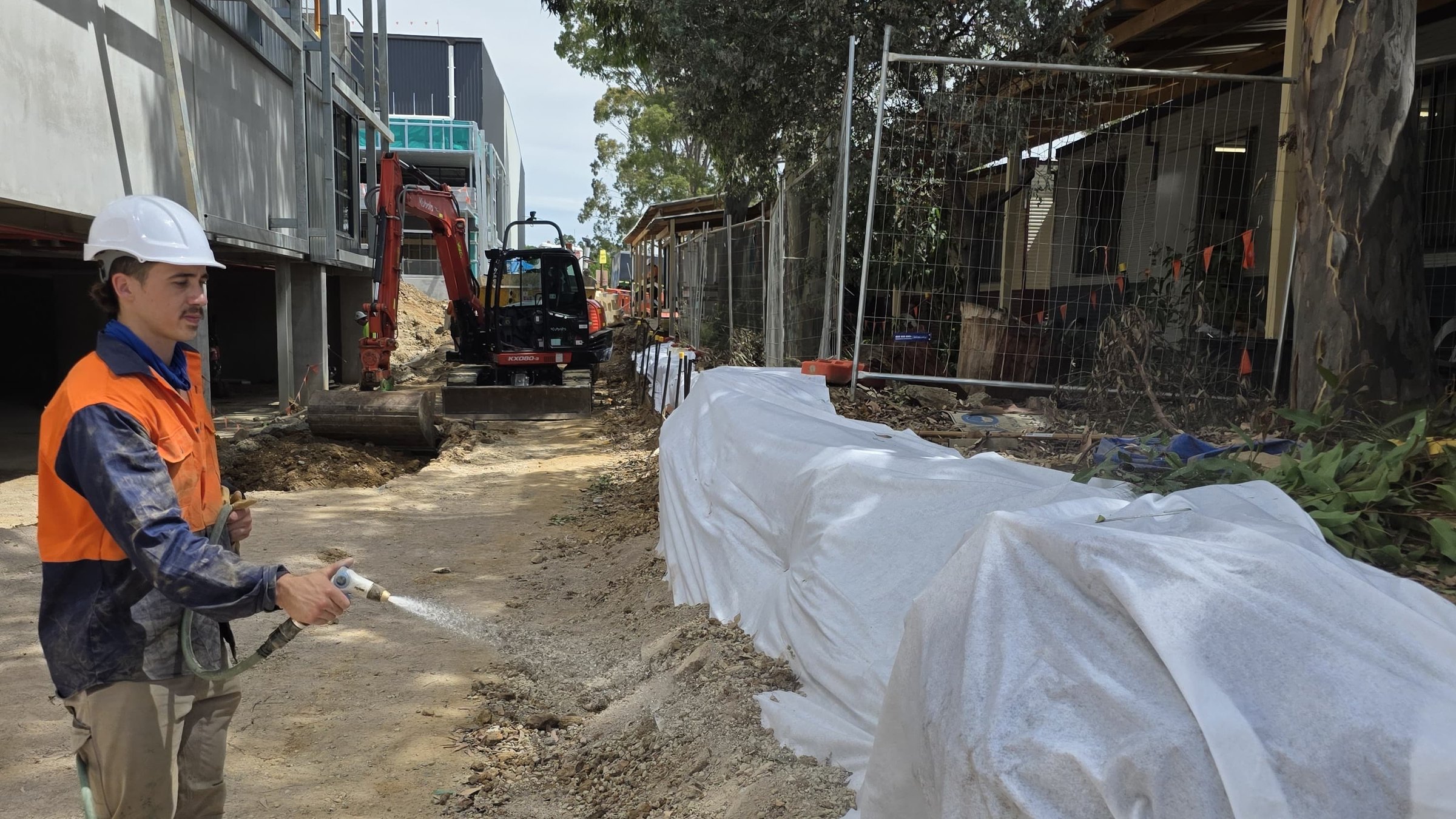
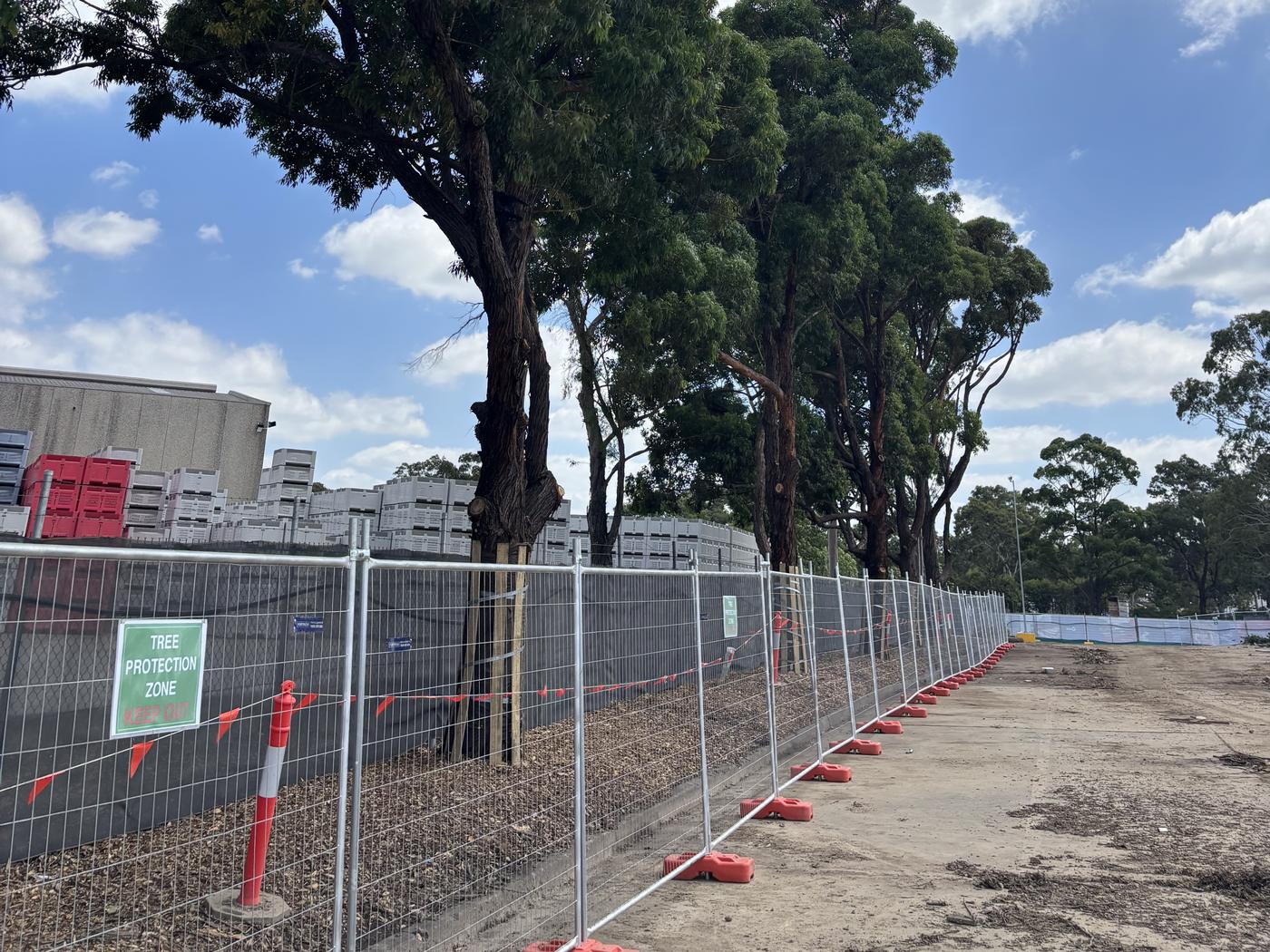
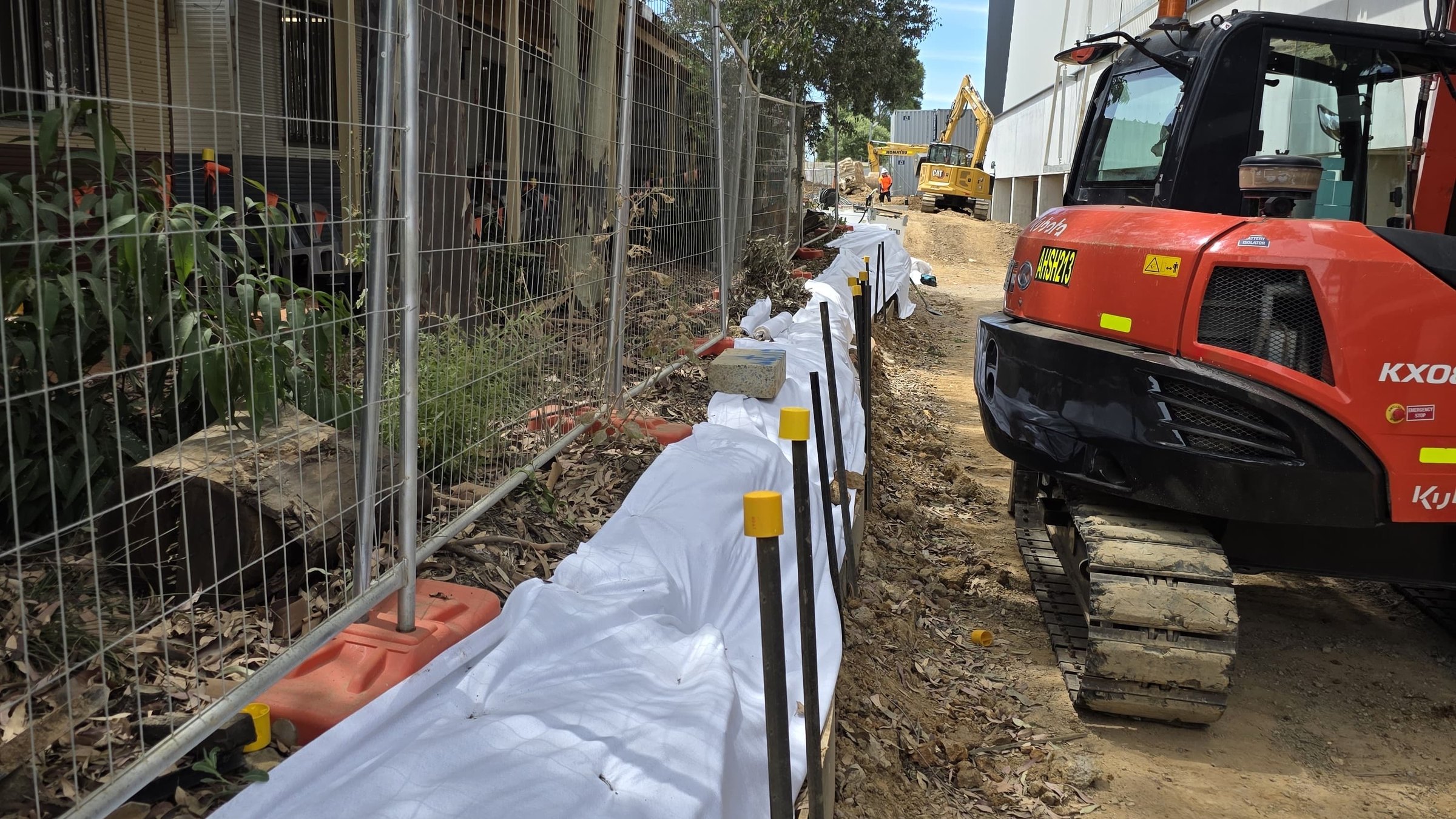

Photos from our own jobs. Client addresses are never published.
Project arborist hold points and inspections
A hold point is a stage where work stops until the project arborist has inspected and signed off. The plan for your site names them. The City of Ryde Tree Management Technical Manual (Table 4.2) is a good example of the usual stages:
| Stage | Project arborist |
|---|---|
| Pre-construction (before demolition) | Marks trees for retention, pruning, removal or transplanting, specifies any pruning, certifies that work once it is done, and certifies the protection is installed to the plan |
| Completion of site establishment | Inspection and report |
| Installation of services | Inspection and report |
| Footings and slabs | Inspection and report |
| Erection of scaffolding | Inspection and report |
| Any work inside a zone | Inspection and report, for any tree on or next to the site, including street trees |
| Completion of building works | Inspection and report |
| Practical completion | Inspection and report once construction and landscaping are finished |
| End of the defects liability period | Certifies the protection was complied with and assesses each tree’s condition. Where it was not complied with, details the non-compliance and its impact on the trees and recommends remedial work, then certifies that work is complete |
Every visit is written up and dated, so the certifier has a paper trail for the occupation certificate.
What a tree protection plan includes
In the plan
- A scaled site plan with every retained tree, including neighbours’ trees and street trees whose zones the works reach
- The root zone, TPZ and SRZ for each tree, and the encroachment percentage where works cross them
- Fencing, ground protection and trunk protection, with where each goes
- No-go activities inside the zones: storage, washout, fill, parking and stockpiles
- Protection through every stage, from demolition and excavation to landscaping
- The hold-point inspection schedule
What to send us for a quote
- The consent conditions (DA or CDC)
- The stamped architectural plans and survey
- Any arborist report or impact assessment already done
- Your construction program, if you have one
We read the conditions and plans before we price, so the quote matches what the certifier will ask for. See also arborist reports and commercial and builder tree services.
If a protected tree is damaged during works
- Stop work near the tree and keep machinery out of the zone.
- Call the project arborist the same day. Photograph the damage.
- The arborist inspects, records the damage and prescribes remedial work, such as clean pruning of torn roots, irrigation or mulching.
- The arborist reports to the certifier, and council where the consent requires it.
Offences under the Environmental Planning and Assessment Act 1979 carry maximum penalties set by tier: Tier 1 up to $5 million for a corporation and $1 million for an individual, Tier 2 up to $2 million and $500,000, and Tier 3 up to $1 million and $250,000, plus daily penalties while the offence continues. Most matters are heard in the Local Court, where the maximum is $110,000 (s 9.57(3)). For damage to trees, the court can also order new trees planted and maintained to maturity. Source: Judicial Commission of NSW, Local Court Bench Book.
Builders, developers, homeowners and landscapers
Builders and developers
One contact for the arborist report, the protection plan, the fencing, the root work and the certification, with inspections booked around your program.
Homeowners
Pools, extensions, granny flats and driveways near a protected tree. We tell you early what can be built where, and handle the paperwork the certifier needs.
Landscapers and pool builders
Arborist supervision for excavation inside a zone, root pruning done properly, and a letter for your client’s file confirming the tree was protected.
Tree protection zone questions
What does TPZ stand for?
TPZ stands for tree protection zone. It is the area around a retained tree that is fenced off and protected while building work goes on, so the roots and canopy survive the job. Under AS 4970:2025 the calculated root area is called the nominal root zone (NRZ), and TPZ refers to the above-ground protection set out on site.
What is the difference between the TPZ, NRZ and SRZ?
The NRZ is the calculated root area: 12 times the trunk diameter at 1.4 m, as a radius. The TPZ is the protection actually set out on site: fencing, trunk and ground protection. The SRZ (structural root zone) is the smaller area close to the trunk that holds the tree upright. Under the 2009 standard the calculated area was itself called the TPZ, which is why older consents and council manuals still use that term.
How do you calculate a tree protection zone?
Multiply the trunk diameter at 1.4 m above ground (in metres) by 12. That gives the radius of the zone, with a minimum of 2 m and a maximum of 15 m. A tree 50 cm across has a 6 m radius, an area of about 113 m². The calculator on this page does the sums, and the project arborist confirms them on site.
Is it the nominal root zone or the notional root zone?
The summaries of AS 4970:2025 we have read use nominal root zone (NRZ). Some council documents write notional root zone. Both describe the same calculated area, so go by the wording in your own consent conditions.
What are the TPZ fencing requirements?
Your consent and your council’s specification decide. As an example, the City of Ryde technical manual asks for 1.8 m high, fully supported chain-mesh fencing with a lockable opening, not moved without the project arborist’s approval, and at least two 600 x 500 mm “Tree Protection Zone – Keep Out” signs showing the project arborist’s name and number.
Can I build inside a TPZ?
Sometimes. Under AS 4970-2009 an encroachment of up to 10% was minor. The 2025 edition provides for moderate encroachment up to 20%, and 20 to 30% with root mapping and tree-sensitive design. Work in the SRZ, or over 30%, needs specific justification from the project arborist. Councils that still work to 2009 may treat anything over 10% as major. Pier-and-beam footings, suspended slabs and moved services are the usual answers, and the cheapest time to sort them out is before the plans are lodged.
Do I need a project arborist?
If your consent conditions name AS 4970, a tree protection plan or a project arborist, yes. Read the conditions for neighbours’ trees and street trees as well: protection usually covers any tree whose zone your works reach, not only trees on your own block.
When should the project arborist start?
Before demolition or any machinery arrives. The protection has to be in place and inspected first, then the arborist attends each stage the plan names through to the end of the job.
What is a tree protection plan?
A scaled plan of the site showing every retained tree, its zones and the protection measures (fencing, ground protection, trunk protection, no-go areas), with the inspection schedule from demolition to completion. It often sits inside an arboricultural impact assessment, or is issued on its own once the design is fixed.
Is AS 4970-2009 still used?
The 2009 edition was superseded in 2025, but many consents issued before then, and several council manuals, still name it. Work to the edition your consent conditions name and ask your certifier if the conditions are unclear.
How much does a tree protection plan cost?
Our AQF Level 5 arborist reports for council are mostly $1,500 to $2,000 ex GST. Tree protection plans, impact assessments and project arborist inspections are quoted per site, because the number of trees and hold points varies. More than one tree, or an impact assessment for a development, adds to the total. Send us the consent conditions and plans and we give one fixed price.
What happens if a protected tree is damaged during works?
Stop work near the tree and call the project arborist the same day. The arborist inspects, records the damage, prescribes remedial work and reports to the certifier. Offences under the Environmental Planning and Assessment Act 1979 carry penalties set by tier, and for damage to trees the court can also order new trees planted and maintained to maturity.
Can True Roots fit the root barrier and do the tree work too?
Yes. We are a tree removal, pruning and landscape construction company as well as consulting arborists, so the crew that writes the plan can also prune the roots, fit the barrier, fence the zone and remove the trees the consent allows.
What our clients say
Real reviews from Sydney clients, quoted from our Google profile. Long reviews are shortened; tap Read more for the full review on Google.
 Reviews
…Really great service, professional, safe and accommodating. Difficulties of access easily overcome, good people to deal withRead more
 David G.October 2026
Jimmy and the guys were excellent at their job—very fast and very tidy. I highly recommend them, and I certainly wouldn't hesitate to use them again in the future. "True Roots" are the best.
Nomikos R.October 2026Removed 4 bunches of palm nuts and tidied everything up. Great job.
Matthew K.October 2026Jimmy and his crew were fast, efficient and professional! He was so helpful in removing a tree in our yard that was a safety hazard. I highly recommend True Roots and would not hesitate to use them again if needed.
Liz B.June 2026Jimmy and his team were excellent. Fast, reliable, well-priced and impressive work. Great to see such a good, local tree removal business and arborist in Mortdale and operating in the St George area. You will not be disappointed using these guys.
Jamie D.April 2026Great service! I liked how they cleaned up after they chopped down our tree. Efficient and very competitive pricing. I would happily book them again in the future.
Celia L.April 2026Jimmy and the two men working with him were professional, hard working and efficient with their time. They removed a large bougainvillea adjacent to the pool. I was very impressed with how well they did this, especially given how thorny it…Read more
Jan B.March 2026I recently hired True Roots to remove a large gum tree from my property, and I couldn’t be more impressed with their service. From the initial consultation to the final clean-up, the team of arborists were professional, efficient, and…Read more
Joseph2025Jimmy was amazing; right from the beginning, he was informative, professional and willing to work within our budget. We could not be happier with what he has delivered for us. We removed all our side trees and replaced them with hedges and…Read more
JJ2025Highly recommend the Team from True Roots, the boys came in and removed a Black Butt that was overhanging our house. Very competitive pricing and managed to squeeze us in. The stump was ground back and all waste was removed. Very professional and skilled workers. Will definitely use them again in the future.
Ben G.2024Highly recommend! James and the boys did an amazing job cutting down a large tree in my yard. Super professional, efficient, and left everything clean and tidy. Great service, and I’m really happy with the results. Will definitely call again for any future tree work! Thanks Andrew
Andrew M.2024Qualified, insured and accountable
- AQF Level 5 arboristDiploma of Arboriculture (AHC50524), TAFE NSW, 2024. About 15 years in arboriculture.
- ISO 9001 certifiedQuality management system certified to ISO 9001.
- $20M public liabilityPlus icare workers compensation. Certificates of currency sent with every quote.
- Australian StandardsTree pruning and trimming to AS 4373, tree protection on building sites to AS 4970.
- Indigenous-ownedOwned and operated by an Indigenous director. Registered NSW Government supplier on buy.nsw.
- 5.0 on Google71 reviews, every one from a real job. Read them.


Got a consent condition with AS 4970 in it?
Send the conditions and the site plan with your suburb. We quote the tree protection plan, the fencing and root work, and the inspections as one fixed price, and we call back the same day.
Get a free quote
Tell us what you need done and we will call you back to arrange a look. Every job is assessed individually - no two trees are the same.
Urgent or unsafe tree? Call 0422 023 242 - we answer 24 hours.