Consulting arborist reports. Mortdale based, Sydney wide.
Arborist Reports Sydney — AQF Level 5 Consulting Arborist
Council-ready arborist reports by an AQF Level 5 consulting arborist: DA impact assessments, removal permits, risk and root reports, tree protection plans. Send the plans and we quote the report the same day.
★ 5.0 from 64 Google reviewsAQF Level 5 arboristsISO 9001 certified$20M public liability
★ 5.0 Google rating (64 reviews)✔ AQF Level 5 consulting arborist✔ Arboriculture Australia registered member✔ ISO 9001 certified✔ $20M public liability✔ Reports $1,500–$2,000 ex GST
Arborist reports Sydney
A council-ready arborist report, written by the arborist who inspected the tree.
True Roots writes arborist reports for Sydney councils, development applications, insurers, strata committees and neighbour disputes. They are prepared by an AQF Level 5 consulting arborist — Diploma of Arboriculture, TAFE NSW, and a registered consulting and practising member of Arboriculture Australia — with roughly fifteen years on the tools behind the assessment. Most reports are $1,500–$2,000 ex GST. Send the address and the plans and we quote it the same day.
The point of a report is that it gets accepted. A cheap report that comes back from council asking for information costs you a month, and often a second report. Ours are written to the assessing officer’s own template and thresholds, with the photographs and measurements they will look for, so the application moves the first time it is lodged.
Types of report
What we are usually asked to write.
Development application (DA) arborist report
An Arboricultural Impact Assessment for a DA: every tree on and adjoining the site surveyed, retention values, the impact of the proposed footprint on root zones, and the tree protection measures the consent will require. Written to AS 4970-2009.
Tree removal permit report
The report that goes with a council tree application: species, dimensions against that council’s protection threshold, condition, the reason for removal and the replacement planting the council will ask for. See our council guides.
Tree health assessment
A written assessment of a declining, damaged or suspect tree — crown condition, pests and pathogens, structural defects, and whether it can be retained with works or has reached the end of its safe life.
Tree risk assessment
Condition, defects, targets and likelihood of failure documented with a recognised risk method, so an owner, strata committee or insurer has evidence rather than opinion for the decision they have to make.
Tree protection plan (AS 4970)
Tree Protection Zone and Structural Root Zone calculated for each retained tree, fencing and ground-protection specified, and the monitoring and certification a consent condition requires during construction. See tree protection zones.
Root investigation and mapping
Where roots are blamed for a crack, a lifted path or a blocked pipe, we expose and map them and report what the tree is and is not responsible for. An AS 4970 assessment with root mapping is quoted as two site days plus the report. See root barriers.
Neighbour and boundary disputes
An independent written assessment of condition, encroachment and risk for owners on either side of a fence, including matters heading to the Land and Environment Court.
Pre-purchase tree inspection
Before you buy: what the trees on the block are, what condition they are in, which ones are protected, and what it will cost to deal with them. Cheaper than finding out afterwards.
Insurance and storm damage
What failed, why it failed and what it will take to make the site safe, documented for the claim after storm damage or a tree failure. See emergency tree work.
What it costs
$1,500–$2,000 ex GST for most reports, and why we are not the $400 option.
A single-tree report for a council removal application sits at the lower end. A multi-tree Arboricultural Impact Assessment for a development, or anything needing root mapping or court-standard evidence, sits at the top or is quoted by the day — an AS 4970 assessment with root mapping is two site days plus the report. Every job is quoted individually once we know the number of trees, the access and the deadline.
You will find reports advertised at three or four hundred dollars. They are usually written from photographs, to a generic template, by someone who will never stand under the tree. Councils know the difference, and the cost of a rejected application — a month lost and a second report — is more than the difference in fee. What you are paying for here is an AQF Level 5 arborist on site, measurements and photographs taken properly, the report written to your council’s own format, and someone who will answer the assessing officer’s questions afterwards.
Most reports are delivered within days of the site inspection, and urgent turnarounds can be arranged where a settlement, hearing or lodgement date is fixed. Tell us the deadline when you call.
Inside the report
What you actually receive.
Tree identification and measurements
Species, height, canopy spread, trunk diameter at breast height, age class and position, measured against the protection threshold your council actually applies.
Condition and structural assessment
Crown, trunk, root plate and union condition, defects, decay indicators and pathogens, with photographs so the assessor sees what the arborist saw.
Risk rating with reasoning
Targets, likelihood of failure and consequence, assessed with a recognised method and explained, not just a number in a box.
Recommendation and works specification
Retain, prune or remove — and if works are recommended, they are specified to AS 4373 so whoever carries them out has no room to improvise.
Tree protection detail where a DA applies
TPZ and SRZ figures, fencing, ground protection, permitted works inside the zone and the supervision the consent will require, to AS 4970-2009.
Replacement planting schedule
Species, size and location for the replacement trees councils increasingly make a condition of approval, so that condition is answered before it is raised.
Council thresholds
Whether you need a report at all depends on your council.
Sydney councils each set their own trigger for when a tree is protected and when a report has to accompany the application. Georges River protects trees from 3 metres. Sutherland Shire protects from a 100 mm trunk measured at 500 mm above ground. Ku-ring-gai protects from 5 metres. Others work from canopy spread or a heritage or bushland overlay instead. A tree within 3 metres of a dwelling is generally exempt from council tree controls.
We check the rule that applies to your address before quoting, and if the honest answer is that you do not need a report, we tell you that instead of writing one. Send a photo and the address and we will say which it is. Our council tree removal guides set out the thresholds and forms for Georges River, Sutherland Shire, Bayside, Canterbury-Bankstown, Inner West and City of Sydney.
How it runs
Four steps from the phone call to the lodged application.
Tell us the purpose
Council application, DA, insurance, dispute or peace of mind — and the deadline. Send the address, photos and any plans or council correspondence.
Site inspection
An AQF Level 5 arborist attends, measures and photographs every tree in scope, and checks the constraints the council will care about.
The report
Written to the council’s format with findings, risk rating, recommendation and the protection or planting detail the consent will need. Delivered as a PDF you can lodge.
After lodgement
We answer the assessing officer’s questions, and if the work is approved the same company can carry it out — no second contractor to brief.
Project experience
Commercial TPZ management — Texco, Minto.
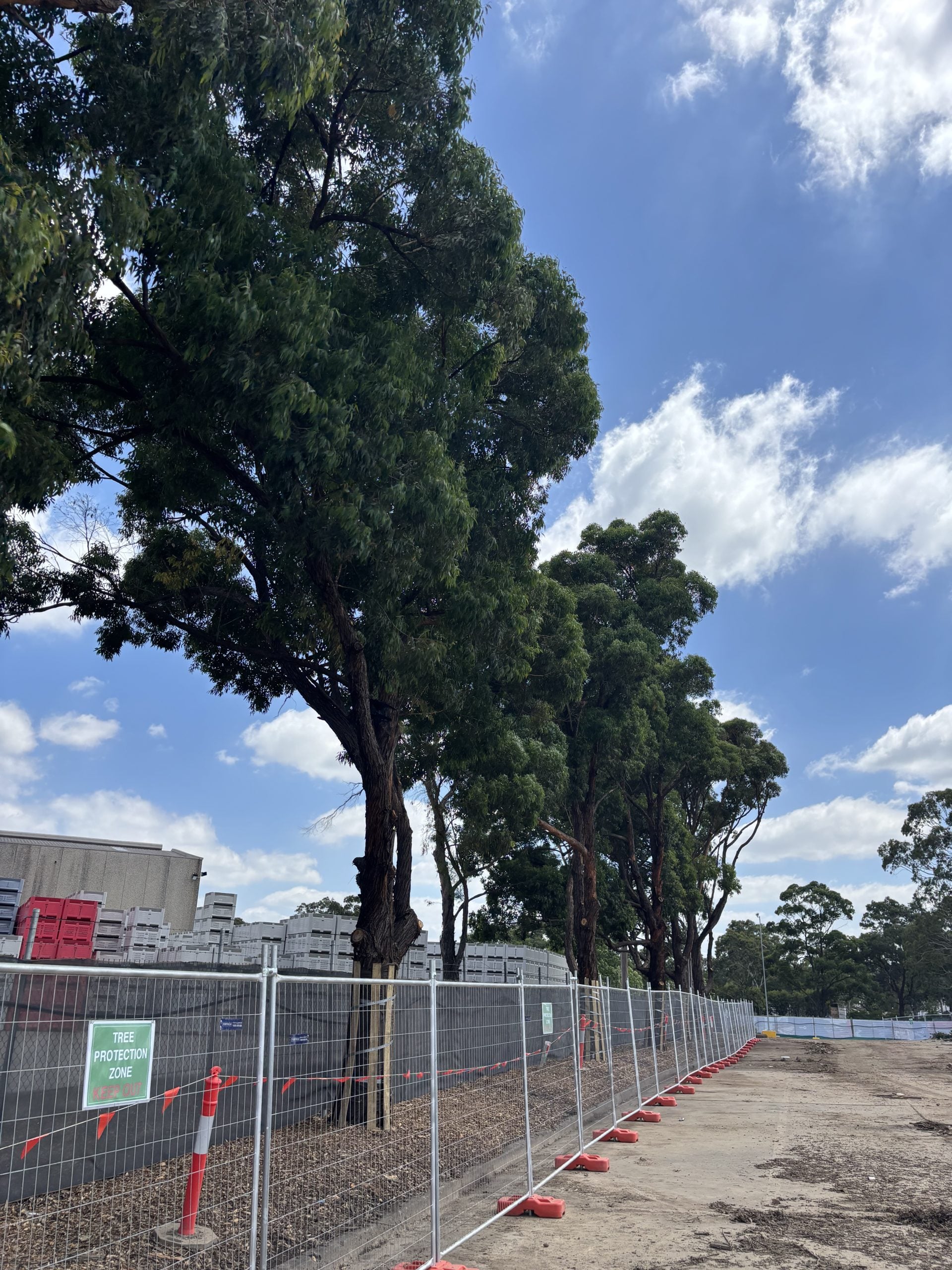
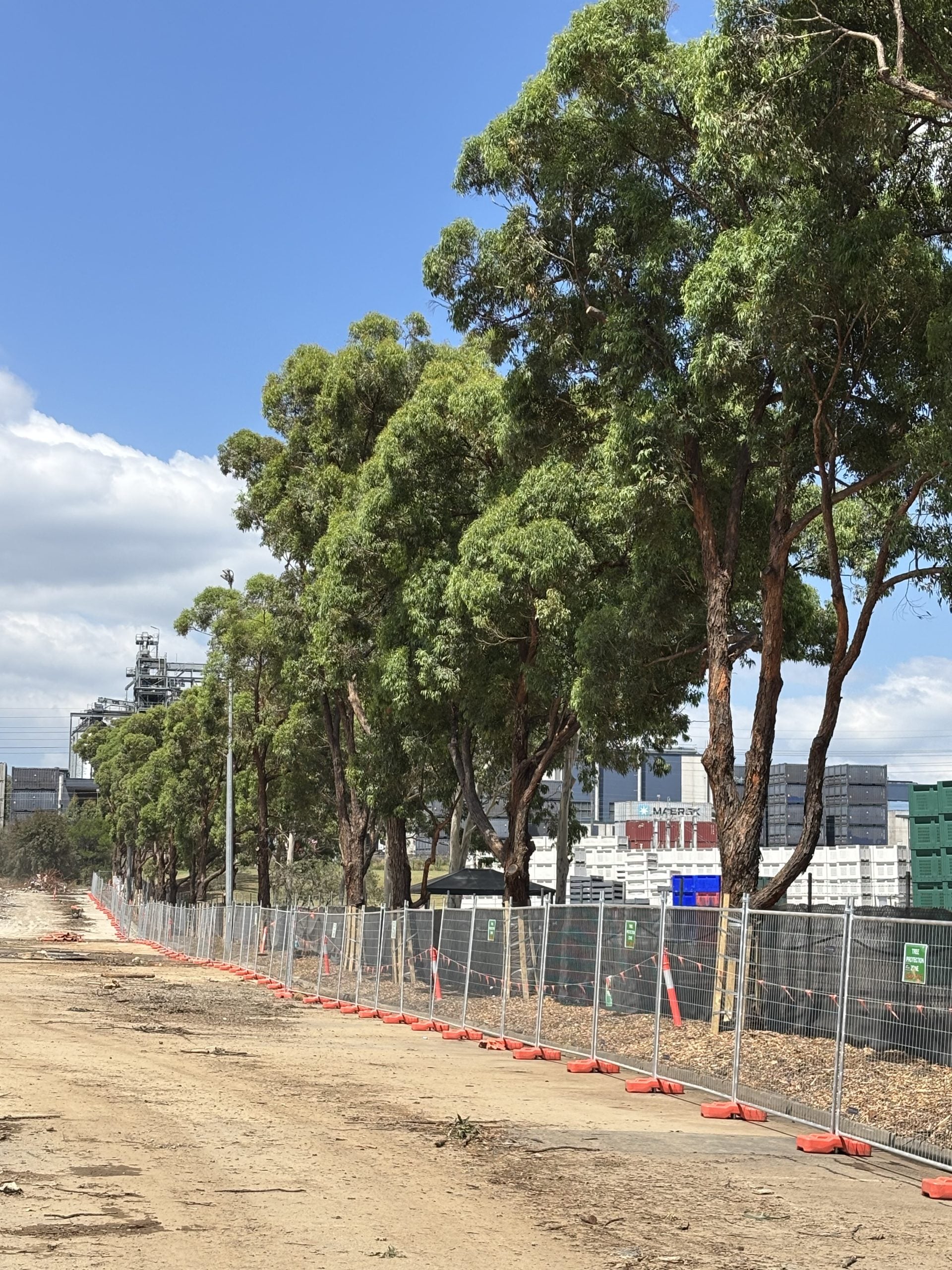
True Roots was the consulting arborist on a commercial Texco development at Minto. We supplied the initial Arboricultural Impact Assessment, acted as the consulting arborist through construction, and provided the final certification on completion — managing the Tree Protection Zone from start to finish across a two-year period. That is the full arc a DA consent condition actually asks for: the assessment, the supervision, and the sign-off at the end.
Tree Protection Zone in place — fencing, ground protection and exclusion set out to AS 4970 before works started.Certified on completion — trees retained, monitored through construction and signed off for the consent condition.
Why this arborist
Qualified to write it, and able to do the work afterwards.
AQF Level 5 consulting arborist
Diploma of Arboriculture (AHC50524), TAFE NSW — the qualification councils name when they ask for a Level 5 report, and the level required to hold the Project Arborist role under a DA consent.
Registered professional memberships
Arboriculture Australia registered consulting and practising member, and a member of the International Society of Arboriculture.
Roughly fifteen years on the tools
The assessment is written by someone who has spent fifteen years removing, pruning and rigging these species in these suburbs — not only reading about them.
Report and works from one company
Report specialists cannot carry out the approved work; tree crews often cannot write the report. True Roots does both, so the recommendation and the job that follows come from the same people.
ISO 9001 certified, $20M insured
Audited quality management, $20M public liability and icare workers compensation, with certificates of currency supplied on request for builders, strata and councils.
5.0 from 64 Google reviews
Every one from a real job across the St George area, the Sutherland Shire, the North Shore and Western Sydney.
Common questions
Arborist reports, answered plainly.
How much does an arborist report cost in Sydney?
True Roots reports are $1,500–$2,000 ex GST for most jobs. A single-tree council removal report is at the lower end; a multi-tree development impact assessment, or one needing root mapping or court-standard evidence, is at the upper end or quoted by the day. Cheaper reports exist, usually written to a template from photographs, and they are the ones councils send back.
What is in an arborist report?
Tree identification and measurements (species, height, spread, trunk diameter), an assessment of health and structural condition with photographs, a risk rating with the reasoning behind it, and a clear recommendation to retain, prune or remove. Where a development is involved it also covers Tree Protection Zones and construction impacts to AS 4970-2009, plus any replacement planting the council will require.
Do I actually need a report for my council application?
Often, but not always. Each Sydney council sets its own trigger — Georges River from 3 metres, Sutherland Shire from a 100 mm trunk at 500 mm, Ku-ring-gai from 5 metres — and a tree within 3 metres of a dwelling is generally exempt from council tree controls altogether. Send us the address and a photo and we will tell you honestly whether you need one.
What is an AQF Level 5 arborist, and why do councils ask for one?
AQF Level 5 is the Diploma-level arboriculture qualification. It is the level councils specify for reports supporting applications and development consents, and the level required to act as the Project Arborist named in a consent condition. A Level 3 arborist is qualified to do tree work but not to write these reports.
My neighbour’s tree overhangs my property in NSW — what can I do?
You can generally prune back to the boundary at your own cost, but the tree is still your neighbour’s and protected species and council controls still apply, so cutting first can be expensive. An independent report documenting condition, encroachment and risk is what the Land and Environment Court and most councils will want if the matter does not settle over the fence.
Can a report guarantee my application gets approved?
No, and be wary of anyone who says otherwise — the decision is the council’s. What a properly written report does is make sure the decision is made on the evidence, at the first attempt, rather than delayed because information is missing. If the tree does not warrant removal we will tell you before you pay for a report.
How soon can you inspect, and how fast is the report?
Inspections are usually available the same week. Most reports are delivered within days of the inspection, and urgent turnarounds can be arranged where a settlement, hearing or lodgement date is fixed. Tell us the deadline up front.
Can True Roots do the tree work after the report?
Yes, and it is the main reason people come to us rather than a report-only consultancy. Once the council signs off, the same company carries out the removal, pruning or protection works — AQF Level 5 arborists, own crane and machinery, $20M public liability, site left clean.