
Mortdale based. Sydney wide. 15 years on the tools.
Neighbour's tree roots damaging your property in NSW: your options
AQF Level 5 arborists, $20M public liability and council paperwork handled. Tell us about the job and we call you back the same day.
★ 5.0 from 71 Google reviewsAQF Level 5 arboristsISO 9001 certified$20M public liability
Your options when a neighbour's tree roots cause damage
Roots from next door lifting your paving, cracking a wall or getting into your pipes is stressful, and cutting them yourself can make things worse. Here is how the process works in NSW, what evidence the Land and Environment Court and councils look for, and how an AQF Level 5 consulting arborist report helps. This is general information, not legal advice.
Start here: four practical steps
- Record the damage. Take dated photos of the cracks, lifted pavers or wall movement, with something for scale. Legal Aid NSW suggests photos, talking to your neighbour, getting a report from an arborist and getting a written quote for repairs (Legal Aid NSW).
- Talk to your neighbour. This is the first step, and Legal Aid NSW notes a mediator can help if talking stalls. If it ever goes to court, the Court must be satisfied you made a reasonable effort to reach agreement first (s 10(1)(a), LEC annotated Trees Act).
- Do not cut first. Legal Aid NSW notes some trees are protected, you can be fined for interfering with a protected tree, and going onto your neighbour’s land without permission may be trespass (Legal Aid NSW). Georges River Council, for example, requires approval for cutting tree roots unless exempt (Georges River Council). If the Court later orders work to the tree, that work can usually go ahead without a separate council tree permit, although other Acts may still require consent (s 6(3), LEC annotated Trees Act).
- Get expert evidence. Find out whether the roots really are causing the damage, whose tree they belong to, and what the fix costs. That is where an arborist report comes in.
Not sure the roots are the cause? Send two photos (the damage and the tree) through the quote form (up to 6 photos) or call 0422 023 242. No call-out fee.
The Trees (Disputes Between Neighbours) Act 2006 in plain English
The Act lets an owner or occupier apply to the Land and Environment Court (LEC) for orders when a tree on adjoining land has caused, is causing, or is likely in the near future to cause damage to their property, or is likely to injure someone (LEC, tree disputes). Key points from official sources:
- Not council trees. The Act applies to trees on land in urban zones, but not to trees on land vested in or managed by a council. It may still apply to trees on some other government land, such as public housing and schools (s 4(2)(a), LEC annotated Trees Act).
- Whose tree. The tree must be wholly or principally on the neighbour’s land (LEC annotated Trees Act).
- “Near future” is usually taken as 12 months. In Yang v Scerri [2007] NSWLEC 592 the Court applied a “rule of thumb” of 12 months, and later cases have followed it (LEC annotated Trees Act; State Library of NSW, Legal Answers).
- The Act replaces nuisance claims. You cannot sue in nuisance for damage from a tree the Act applies to; you use the Act instead (s 5, LEC annotated Trees Act).
- Councils cannot order your neighbour. The City of Sydney says councils do not have the authority to order a resident to prune or remove a tree affecting a neighbour (City of Sydney).
- Notice and filing. The neighbour and the council must be served at least 21 days before the preliminary hearing (LEC, how to start). The filing fee is $320 standard ($639 for a corporation) in the schedule updated 1 July 2026; check the LEC fee schedule for the current fee.
- Time limits. There is no time limit in the Trees Act to apply, but compensation claims for property damage generally have a six-year limit under the Limitation Act 1969 (LEC; Legal Aid NSW). Get legal advice on when that period starts for you.
- Timing and costs. The LEC says applications are usually dealt with within three months of filing (LEC, outcomes and orders). Costs orders are generally not made in tree disputes, and each party pays its own expert fees and preparation costs (LEC, Trees and hedges).
Who pays for damage from a neighbour’s tree roots?
Ideally you agree it with your neighbour. If you cannot, the Court can order the tree owner to pay for repairs, but only where it is satisfied the tree caused the damage. Being close to the tree is not enough on its own; the Court looks at all the evidence for a causal link, which may show other causes (Smith & Hannaford v Zhang & Zhou [2011] NSWLEC 29, LEC annotated Trees Act).
In Dean v Ellsworth [2010] NSWLEC 1032 the Court found the trees contributed to the driveway damage but the driveway’s age and construction were the main causes. It refused to order the trees removed, and ordered the two damaged sections of driveway replaced without damaging major roots, with the tree owners contributing 40% of the cost (State Library of NSW).
The Court’s “tree was there first” principle says the tree being there first should not affect whether an order is made, but it can be relevant to who pays for the work (Black v Johnson (No 2) [2007] NSWLEC 513, LEC annotated Trees Act).
What the Court can order
Examples the LEC lists include removing a tree, grinding its stump and removing offending roots; paying to repair or replace sewer pipes, cracked walls or paths badly damaged by tree roots; and paying to install a root control barrier (LEC, Trees and hedges).
The Court’s annotated Act also lists orders for re-laying paths or driveways, re-laying courtyard paving, repairing retaining walls, replacing or cleaning sewer pipes, installing root barriers and root pruning (LEC annotated Trees Act, s 9). Diagnosis decides the outcome.
Proving the roots caused the damage
In Fang v Li [2017] NSWLEC 1503, the Land and Environment Court set out a tree dispute principle on proving that tree roots caused structural damage. The person making the claim has to prove it. The tree only needs to be one cause, not the only cause, but where other causes have not been ruled out, the link between the tree and the damage has to be clearly shown.
The Court listed investigations that can help. It said the list is not exhaustive:
- which tree the roots near the footings belong to (an arborist can help with species and growth habits)
- the history of the building and the area, including trees removed in recent years
- the age, depth and type of the footings
- which part of the structure has moved, which way, and whether it is still moving
- soil type and soil moisture near the damage, and elsewhere for comparison
- the condition of downpipes and other pipes nearby
The Court said these investigations would ordinarily be expected of an engineer, and that simply recording where the cracks are and how close the tree and roots are will rarely be enough. In that case it accepted that roots had lifted a path and damaged a pipe, which could be seen once the ground was dug, but not that they had cracked the house, where other causes had not been ruled out. General guides about tree species and distances do not prove that a particular tree caused particular damage either.
Our part is the tree and the roots: identifying the tree, exposing and mapping the roots at the point of damage, and reporting what the tree is and is not responsible for. Findings about footings and structural movement come from an engineer, and we work alongside one where the claim needs it.
When an AQF Level 5 arborist report helps
The LEC recommends engaging expert arborists, builders and engineers where an application needs proof of the cause, type, extent and cost of damage (LEC). A report is useful when:
- you and your neighbour disagree about whether the tree is the cause
- you need council approval to prune roots, fit a barrier or remove a tree
- you are making an insurance claim or a claim against a council (some councils, such as Sutherland Shire for tree permits, require a consultant with no link to a tree contractor, and we will tell you if yours does)
- the matter is heading to the Land and Environment Court
- a strata committee or managing agent needs an expert view before approving work
True Roots writes AQF Level 5 arborist assessments of the tree, the roots and the damage for owners on either side of a fence, including for matters heading to the Land and Environment Court.
What our root report covers
- The tree: species, health, and where it stands relative to the boundary
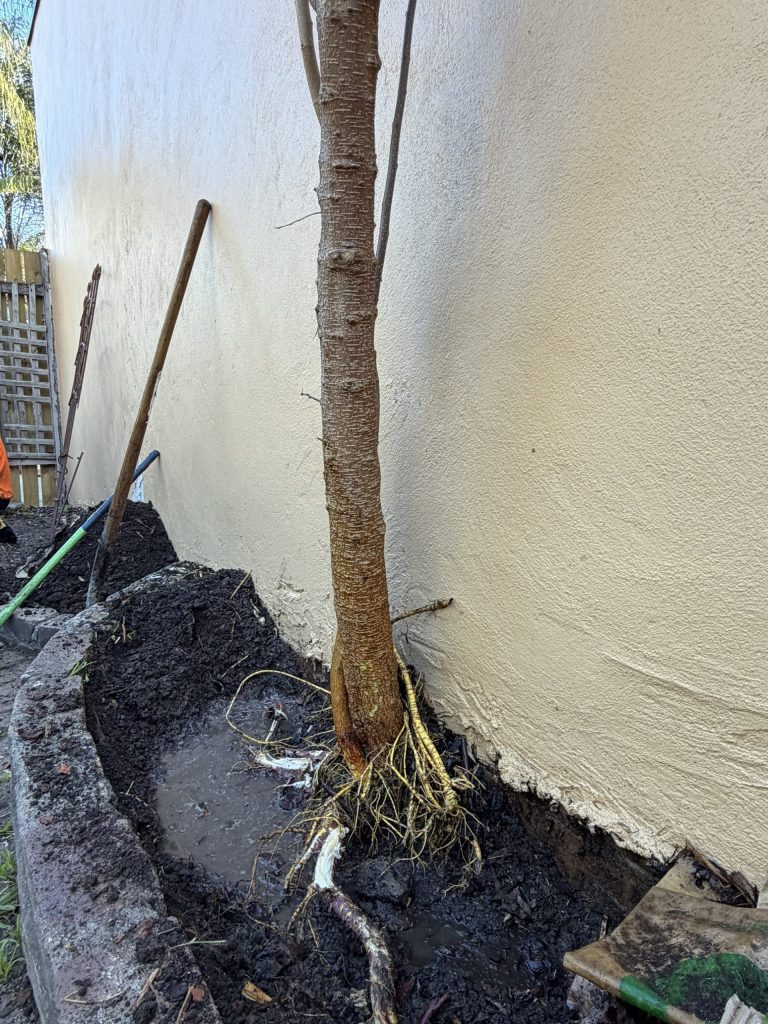
- The roots: exposed and mapped at the point of damage, with what the tree is and is not responsible for
- Options: root pruning within limits the tree can tolerate, a root barrier, or removal where justified, and which need council approval
Structural repairs to houses or slabs need an engineer or builder, and pipe repairs need a licensed plumber. We coordinate with them.
If it's your tree causing damage next door
If a neighbour says your tree's roots are damaging their property, you need the same expert evidence: whether the roots really are the cause, what else contributed (such as the age or construction of a wall or driveway), and what reasonable options exist, like root pruning or a root barrier, before removal is considered. We write AQF Level 5 arborist assessments for tree owners too, including for matters heading to the Land and Environment Court. Check with your council before any root is cut.
If it is a council or street tree
The Trees Act does not cover council trees, so the claim goes to the council. Sutherland Shire Council, for example, asks for expert evidence such as a consulting arborist’s report. To show root interaction, it asks you to engage a professional (such as an arborist or engineer) to do localised excavation at the point of suspected contact, with the roots uncovered carefully and left intact. It says property owners should not cut and remove tree roots, that the claim and evidence should be submitted before any repair work, and that care is needed digging beside brick footing walls or fences above 1.0 m, because a full-length trench may destabilise them (Sutherland Shire Council). Georges River Council asks owners to excavate near the structure’s footings and leave the roots exposed, in place and unsevered for council inspection (Georges River Council).
Then the physical fix
Once the cause and the approvals are clear, the same crew can deal with the roots, fit a barrier, and relay the paving or repair the wall. See tree roots damaging walls and paving for how that job runs.
Pipes. Sydney Water says tree roots can enter small cracks in wastewater pipes, advises against planting trees within 6 metres of them, and lists trees to avoid near pipes, including camphor laurel, jacaranda and figs such as the Moreton Bay fig (Sydney Water, wastewater blockages). You are responsible for the wastewater pipes on your property up to where they join Sydney Water’s network, and a blocked or broken pipe needs a licensed plumber.
What it costs
Our AQF Level 5 arborist reports are mostly $1,500 to $2,000 ex GST. Where roots need to be exposed on site, we quote that first, as one fixed price after we have seen the job. Root work, barriers and repairs are quoted the same way. No call-out fee.
Getting legal help
This page is general information only, not legal advice. For advice on your situation, contact Legal Aid NSW or a lawyer; Legal Aid NSW says you should speak to a private lawyer before you apply to the Court. The LEC also points people to a free Tree Disputes Student Helpdesk for help with procedure (LEC, Trees and hedges). Legal Aid NSW suggests talking to your neighbour first and trying mediation before going to Court. NSW Community Justice Centres now mediate only court-ordered disputes, so for other options call LawAccess NSW on 1300 888 529.
Not sure the roots are the cause? Send us two photos
Photos of the damage and the tree through the quote form (up to 6), or call 0422 023 242. No call-out fee. We will tell you what the roots are likely doing and whether a report is worth it. For branches rather than roots, see our overhanging tree guide. For reports more generally, see arborist reports Sydney.
Neighbour tree root questions
Can I cut my neighbour's tree roots on my side of the fence in NSW?
Do not assume you can. Many councils require approval for root cutting (Georges River says cutting tree roots needs approval unless exempt), and Legal Aid NSW notes you can be fined for interfering with a protected tree. Check with your council first, and get advice if unsure. If you need roots cut, we check the council rules, apply for approval where needed, and cut only what the tree can tolerate.
Who pays for damage caused by a neighbour's tree roots in NSW?
Ideally it is agreed between neighbours. If not, the Land and Environment Court can order the tree owner to pay for repairs or a root barrier under the Trees (Disputes Between Neighbours) Act 2006, but only where it is satisfied the tree has caused, is causing or is likely in the near future to cause damage to your property. Where other causes contributed, costs can be shared: in Dean v Ellsworth the tree owners contributed 40%.
Can the council make my neighbour remove their tree?
No. The City of Sydney says councils do not have the authority to order a resident to prune or remove a tree affecting a neighbour. The next step after talking is mediation or an application to the Land and Environment Court.
Does the Trees Act cover council or street trees?
No. It does not apply to trees on land vested in or managed by a council. Damage from a council tree is claimed through the council, which may ask for expert evidence such as an arborist report, with roots exposed but left uncut (for example Sutherland Shire and Georges River).
Do I need an arborist report for a tree dispute?
It is not always required, but the LEC recommends expert arborists, builders and engineers where you need to prove the cause, extent and cost of damage, and Legal Aid NSW suggests getting an arborist report. Our AQF Level 5 arborist reports are mostly $1,500 to $2,000 ex GST; where roots need to be exposed on site, we quote that first.
How long do I have to make a claim?
There is no time limit in the Trees Act to apply, but compensation claims for property damage generally have a six-year limit under the Limitation Act 1969. Get legal advice on when that period starts for you.
Will my home insurance cover damage from a neighbour's tree roots?
Do not assume it does. Some home policies exclude damage caused by tree roots, so check your Product Disclosure Statement or ask your insurer. If you do claim, an arborist report can help show what caused the damage. See also tree roots damaging walls and paving.
What our clients say
Real reviews from Sydney clients, quoted from our Google profile. Long reviews are shortened; tap Read full review to see it on Google.
 Reviews
…Really great service, professional, safe and accommodating. Difficulties of access easily overcome, good people to deal withRead full review
 David G.October 2026
Jimmy and the guys were excellent at their job—very fast and very tidy. I highly recommend them, and I certainly wouldn't hesitate to use them again in the future. "True Roots" are the best.
Nomikos R.October 2026Removed 4 bunches of palm nuts and tidied everything up. Great job.
Matthew K.October 2026Jimmy and his crew were fast, efficient and professional! He was so helpful in removing a tree in our yard that was a safety hazard. I highly recommend True Roots and would not hesitate to use them again if needed.
Liz B.June 2026Jimmy and his team were excellent. Fast, reliable, well-priced and impressive work. Great to see such a good, local tree removal business and arborist in Mortdale and operating in the St George area. You will not be disappointed using these guys.
Jamie D.April 2026Great service! I liked how they cleaned up after they chopped down our tree. Efficient and very competitive pricing. I would happily book them again in the future.
Celia L.April 2026Jimmy and the two men working with him were professional, hard working and efficient with their time. They removed a large bougainvillea adjacent to the pool. I was very impressed with how well they did this, especially given how thorny it…Read full review
Jan B.March 2026I recently hired True Roots to remove a large gum tree from my property, and I couldn’t be more impressed with their service. From the initial consultation to the final clean-up, the team of arborists were professional, efficient, and…Read full review
Joseph2025Jimmy was amazing; right from the beginning, he was informative, professional and willing to work within our budget. We could not be happier with what he has delivered for us. We removed all our side trees and replaced them with hedges and…Read full review
JJ2025Highly recommend the Team from True Roots, the boys came in and removed a Black Butt that was overhanging our house. Very competitive pricing and managed to squeeze us in. The stump was ground back and all waste was removed. Very professional and skilled workers. Will definitely use them again in the future.
Ben G.2024Highly recommend! James and the boys did an amazing job cutting down a large tree in my yard. Super professional, efficient, and left everything clean and tidy. Great service, and I’m really happy with the results. Will definitely call again for any future tree work! Thanks Andrew
Andrew M.2024Qualified, insured and accountable
- AQF Level 5 arboristDiploma of Arboriculture (AHC50524), TAFE NSW, 2024. About 15 years in arboriculture.
- ISO 9001 certifiedQuality management system certified to ISO 9001.
- $20M public liabilityPlus icare workers compensation. Certificates of currency sent with every quote.
- Australian StandardsTree pruning and trimming to AS 4373, tree protection on building sites to AS 4970.
- Indigenous-ownedOwned and operated by an Indigenous director. Registered NSW Government supplier on buy.nsw.
- 5.0 on Google71 reviews, every one from a real job. Read them.


Neighbour's roots causing damage?
Send photos of the damage and the tree. We tell you what the roots are doing, whether a report will help, and how the damage can be fixed.
Get a free quote
Tell us what you need done and we will call you back to arrange a look. Every job is assessed individually - no two trees are the same.
Urgent or unsafe tree? Call 0422 023 242 - we answer 24 hours.