

Essential landscaping terms every NSW homeowner should know
If you’ve ever sat across from a landscaper and nodded along while secretly wondering what half the words meant, you’re not alone. Many NSW homeowners dive headfirst into outdoor projects without a firm grasp of the industry language, and that gap can cost real money. Misunderstanding a quote, approving the wrong scope, or skipping a permit because you didn’t realise it applied — these are avoidable mistakes. Getting familiar with key landscaping terminology gives you the confidence to communicate clearly with professionals, ask the right questions, and make smarter decisions whether you’re fixing up a tired lawn or planning a full backyard transformation.
Table of Contents
- Core landscaping terms explained
- Permits, professionals, and NSW regulations
- Essential soil, lawn, and irrigation language
- Local climate, plant selection, and sustainable choices
- Revegetation, eco-terms, and cost-savvy practices
- Looking beyond jargon: Our real-world NSW landscaping insights
- Take your NSW landscaping from words to action
- Frequently asked questions
Key Takeaways
| Point | Details |
|---|---|
| Know the basics | Understanding core landscaping terms helps prevent costly miscommunications with pros. |
| Check permits early | Council planning and building permits are often required for major works in NSW. |
| Choose plants wisely | Select species and designs suited to your microclimate for sustainable, low-maintenance gardens. |
| Prioritise expertise | Qualified professionals handle complex terms, planning, and compliance efficiently. |
Core landscaping terms explained
With the foundations set, let’s dig into the core words that shape every landscaping discussion. At the planning stage, you’ll often hear two phrases: Concept Design and Master Plan. A Concept Design is a broad overview — it captures the overall vision, layout, and style without getting into fine detail. A Master Plan goes further, providing detailed drawings, measurements, and specifications that guide the actual build. Think of the Concept Design as the rough sketch and the Master Plan as the blueprint.
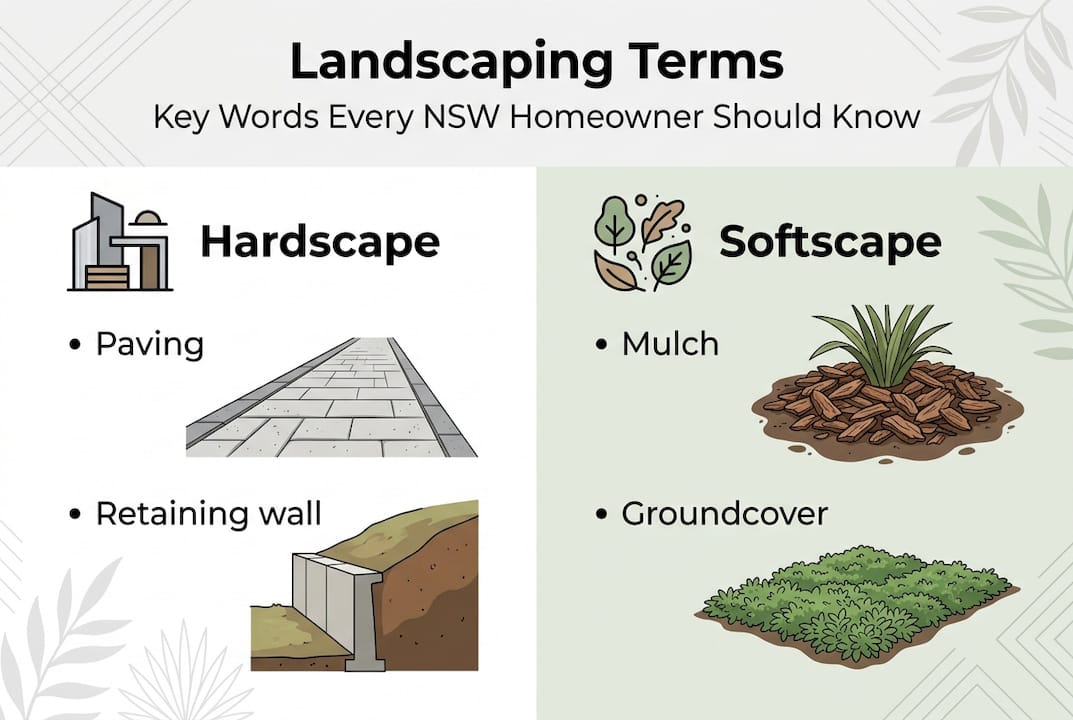
Two of the most important terms you’ll encounter are hardscape and softscape. Key landscaping terminology covers both: hardscape refers to the non-living, constructed elements of a garden — paving, retaining walls, decking, fences, and pathways. Softscape covers everything living: plants, turf, mulch, and soil. A well-balanced outdoor space blends both effectively.
Here’s a quick comparison of common terms:
| Term | What it means |
|---|---|
| Paving | Hard surface materials like concrete, pavers, or stone laid underfoot |
| Decking | A raised or ground-level timber or composite platform |
| Coping | Protective edging along the top of a wall, pool, or garden bed |
| Aeration | Perforating soil to improve air, water, and nutrient flow to roots |
| Thatch | The layer of dead grass and organic matter that builds up above soil |
| Deep watering | Watering slowly and deeply to encourage roots to grow downward |
| Xeriscaping | Designing gardens to use minimal water, often with drought-tolerant plants |
For landscape lighting essentials, the same principle applies — knowing what you’re asking for helps you get exactly that.
When it comes to professional qualifications, planning permits and building permits serve different roles, and the credentials of landscape architects, designers, and landscapers vary significantly. More on that in the next section. If you’re working with a Sydney-based team, our Sydney landscapers guide covers what to expect from professionals in this region.
Pro Tip: Any time a professional uses a term you don’t recognise, stop and ask them to explain it. A good landscaper or designer will never mind — it’s part of the job.
Permits, professionals, and NSW regulations
Understanding the terms is just the start — knowing who does what and the permissions needed is equally vital.
A planning permit relates to how land is used and developed. It’s issued by your local council and is typically required when a project changes the look, use, or structure of your property. A building permit (also called a Construction Certificate in NSW) is needed when the work involves structural elements — think retaining walls over a certain height or major earthworks.
The three main professionals you’ll deal with each have distinct roles:
- Landscape Architect: A university-qualified professional who can design complex sites, including drainage systems, structural elements, and large public or residential projects.
- Landscape Designer: Typically certificate or diploma qualified, focused on aesthetic design and plant selection for residential projects.
- Landscaper: The tradesperson who physically builds and installs the design.
Permits and professional qualifications are clearly defined under NSW planning frameworks, and knowing the difference helps you hire the right person for each stage.
Here’s a simplified look at their roles:
| Professional | Qualifications | Typical role |
|---|---|---|
| Landscape Architect | University degree | Complex design, DA documentation |
| Landscape Designer | Certificate/Diploma | Residential design and planting plans |
| Landscaper | Trade/Certificate | On-ground installation and construction |
For permit applications, here’s a general process to follow:
- Contact your local council to confirm whether your project requires approval.
- Engage a qualified professional to prepare plans if required.
- Lodge a Development Application (DA) or Complying Development Certificate (CDC).
- Await approval before commencing any structural or boundary-affecting works.
Works near property boundaries, particularly retaining walls, drainage, and tree removal, may require council approval under NSW planning legislation — always check before you start.
For a practical example of how this works locally, see how Hornsby Council landscape approvals are typically managed.
Essential soil, lawn, and irrigation language
Now that the roles and rules are clear, let’s turn to the ground itself — where healthy landscapes begin.
Soil pH is a measure of acidity or alkalinity on a scale from 0 to 14. For most NSW turf varieties, the ideal pH range sits between 6.0 and 7.0. Outside this range, nutrients become harder for grass roots to absorb, leading to yellowing and poor growth regardless of how much fertiliser you apply.
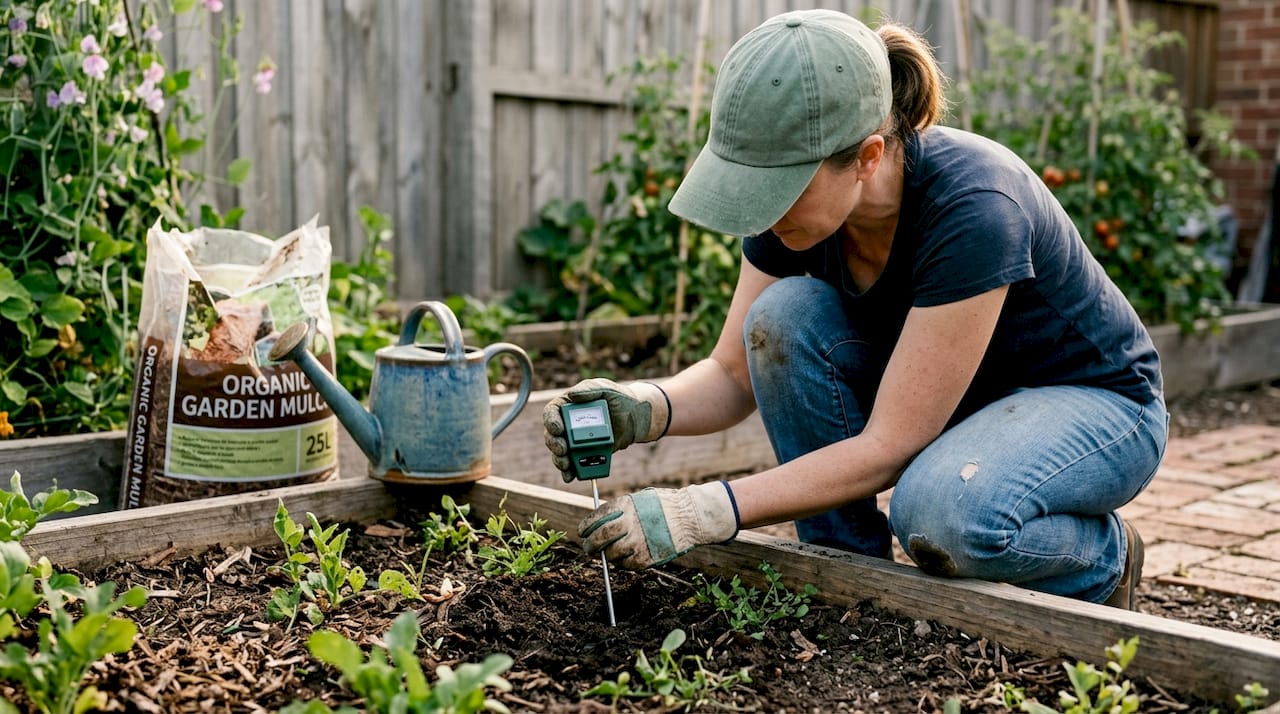
Compaction happens when soil particles are pressed too tightly together, blocking air and water movement. This is common in high-traffic areas and leads to patchy, struggling lawns. NPK refers to the ratio of Nitrogen, Phosphorus, and Potassium in fertiliser — the three key nutrients every lawn needs to thrive.
NSW has three popular turf varieties, each with different strengths:
| Grass type | Sun/shade tolerance | Maintenance level | Best use |
|---|---|---|---|
| Buffalo | Good shade tolerance | Low | Families, shaded yards |
| Couch | Full sun preferred | Medium | Sports fields, open lawns |
| Kikuyu | Full sun | High | Fast-growing, vigorous coverage |
When it comes to watering, deep watering encourages roots to grow downward, making your lawn more drought-resistant. Aeration — using a fork or machine to punch holes into the soil — improves drainage and nutrient flow. Thatch buildup is a silent lawn killer; when the organic layer between grass blades and soil exceeds about 1.5 cm, it blocks water and feeds disease.
Common NSW lawn challenges include:
- Compaction from clay-heavy soils, especially in Western Sydney
- Thatch accumulation in warm-season grasses like Kikuyu and Couch
- Waterlogging during winter in low-lying areas
- Soil acidity in areas with high rainfall
Our NSW lawn care specialists can help diagnose what’s holding your lawn back and recommend the right fix.
Local climate, plant selection, and sustainable choices
Building on soil and grass know-how, let’s ensure your plant choices are suited for NSW’s climate and support long-term sustainability.
NSW spans climate zones 2 through 6, from the warm subtropical coast to cooler inland tablelands. Choosing plants matched to your specific zone is critical for survival and low maintenance. A plant thriving on the Central Coast may struggle in Penrith’s hot, dry summers.
Microclimate describes localised variations within your own property — a south-facing fence creates shade and cool air, while a north-facing brick wall retains heat. Understanding your microclimate helps you place plants where they’ll actually flourish. Deep soil zones are areas with sufficient soil depth and volume to support tree and large shrub root systems. These zones are important for biodiversity and should be protected during construction.
Permeable surfaces are hard surfaces (like gravel or permeable pavers) that allow water to filter through rather than run off. They reduce flooding risk and support groundwater recharge — increasingly important in urban NSW.
Key climate factors to consider when selecting plants:
- Annual rainfall and seasonal distribution
- Frost risk (relevant in Canberra fringe and Blue Mountains areas)
- Soil type (sandy coastal vs. clay inland)
- Exposure to wind and sun
- Proximity to bushfire-prone land
For outdoor plant choices for NSW that match your suburb’s conditions, local knowledge makes a big difference. If you’re in the south of Sydney, our Sutherland Shire planting advice covers species suited to that region specifically.
Pro Tip: Selecting drought-tolerant native species like Lomandra, Grevillea, or Westringia will reduce your watering needs dramatically and support local wildlife at the same time.
Revegetation, eco-terms, and cost-savvy practices
With climate-appropriate choices covered, let’s look at eco-focused strategies and terminology that can save money and help the environment.
Scalping removes excess thatch and old growth to reset a lawn. Deep ripping breaks up compacted subsoil to restore drainage. Direct seeding involves broadcasting native seed directly onto prepared ground — a highly cost-effective method. Water harvesting captures and redirects rainfall to where it’s most needed on your property.
Here are simple steps for affordable backyard revegetation:
- Clear existing weeds and debris from the target area.
- Prepare soil through scalping or light deep ripping.
- Sow appropriate native seed directly onto the surface.
- Mulch lightly to protect seeds and retain moisture.
- Water in well and maintain until seedlings are established.
Direct seeding is the most affordable large-scale native planting method available to NSW homeowners, costing approximately 25% of tubestock-based approaches.
Looking beyond jargon: Our real-world NSW landscaping insights
Here’s something we’ve learnt from years on the ground across Sydney and surrounds: knowing all the right terms doesn’t automatically lead to a successful project. The most costly mistakes we see come not from ignorance of vocabulary, but from poor communication with the professionals involved.
Homeowners sometimes accept a quote without checking whether a planning permit is included in the scope. Others lock in a design before confirming their council’s requirements — only to find the project needs to be redesigned. Terminology gives you a foundation, but asking questions and confirming your expectations in writing is what actually protects you.
Sustainability and permit compliance should always outweigh the visual appeal of an initial design. A beautiful plan that ignores drainage or boundary rules is an expensive problem waiting to happen. Our advice? Always choose the right professional for each part of the job, get everything in writing, and check with your local council early. Those three habits alone will save you more than any glossary.
Take your NSW landscaping from words to action
You now have the language — and that’s a genuine advantage when speaking with landscapers, designers, or council staff. But knowing the terms and having the right team behind you are two different things.

At True Roots, we bring qualified arborists, landscapers, and earthmoving experts together under one roof, so your project flows from planning to completion without the usual confusion. Whether you need help with permits, plant selection, or a full backyard overhaul, we’re here with honest advice and a fair dinkum attitude. Explore our qualified arborist services or discover what’s possible with our outdoor transformations. Get in touch today and let’s bring your vision to life.
Frequently asked questions
What’s the difference between hardscape and softscape?
Hardscape and softscape are two halves of every landscape: hardscape covers non-living elements like paving, decking, and walls, while softscape includes plants, turf, and soil.
Do I need council approval for my backyard landscaping in NSW?
Projects that affect drainage, structure, or neighbouring properties often require council planning or building permits; always check your local council rules before starting work.
Which grass type is best for a shady lawn in Sydney?
Buffalo grass is widely recommended for shaded Sydney gardens thanks to its strong shade tolerance and relatively low maintenance requirements.
What’s the most affordable way to establish native plants in NSW?
Direct seeding is typically the cheapest option for large areas, coming in at around 25% of the cost of planting individual tubestock seedlings.
Recommended
- Maximise your NSW home’s value: landscaping explained
- Understand tree root systems for better NSW landscaping
- Landscaping and gardening in Sydney
- Vegetation management in Sydney
Related True Roots services
Need the real thing done? True Roots are AQF Level 5 arborists and landscapers, fully insured ($20M public liability) and rated 5.0 across the St George area, the Sutherland Shire and Canterbury-Bankstown. Explore tree removal, tree pruning, stump grinding, arborist reports, 24/7 emergency tree work and landscaping & gardening — or get a free quote today on 0422 023 242.
Get a free quote
Tell us what you need done and we will get back to you within 1 business day. Every job is assessed individually - no two trees are the same.
Urgent or unsafe tree? Call 0422 023 242 - we answer 24 hours.
