
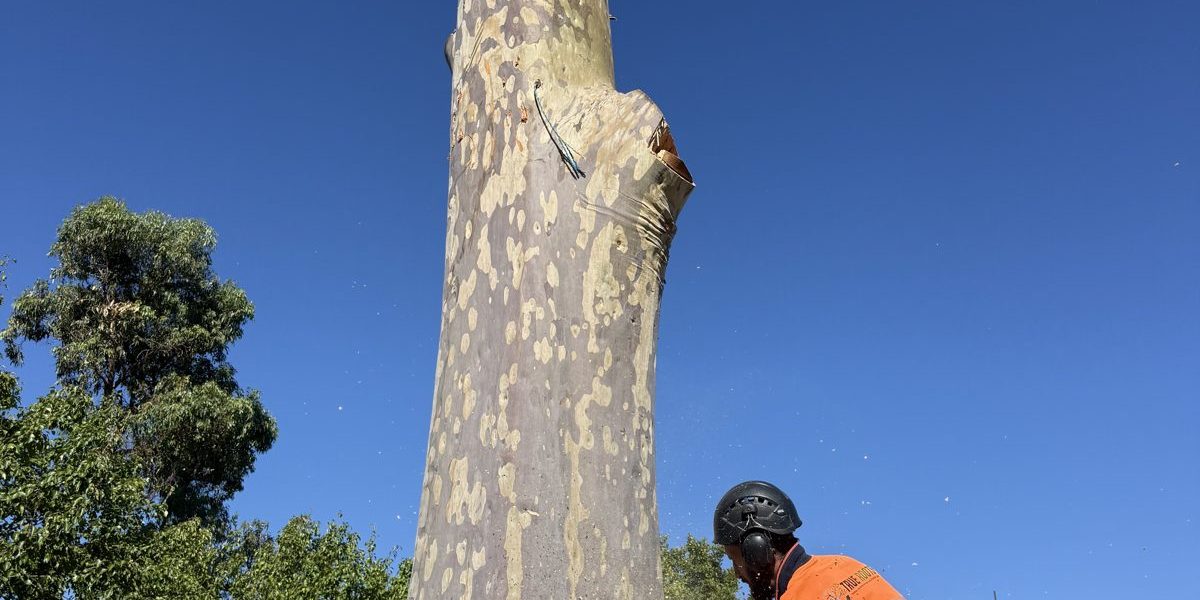
Hazard tree removal: safety and home value explained
Not every tree that looks threatening actually needs to come down. That surprises a lot of NSW homeowners, who assume that if a tree looks risky, it must go. The reality is more nuanced, and getting it wrong can cost you in fines, insurance headaches, or worse, genuine harm to your family or property. Hazard tree removal is a specific, regulated process that covers risk identification, expert assessment, legal compliance, and safe execution. This article walks you through exactly what you need to know, from spotting a hazardous tree to understanding your council obligations and protecting your property’s value.
Table of Contents
- What makes a tree hazardous?
- How experts assess tree risk
- How hazard tree removal is carried out safely
- Legal rules, exemptions, and special NSW situations
- Our perspective: why expert judgement, not just removal, matters most
- Need help with hazard tree removal?
- Frequently asked questions
Key Takeaways
| Point | Details |
|---|---|
| Hazard tree definition | Hazard trees endanger people or property due to defects like rot, lean, or damage. |
| Assessment methods | Professionals use structured risk evaluation to decide the safest action for each tree. |
| Legal requirements | Some removals need council approval, but exemptions exist for truly unsafe situations. |
| Expert involvement | Qualified arborists protect your safety, legal compliance, and home value. |
What makes a tree hazardous?
Not every risky-looking tree is obvious. A perfectly healthy-looking tree can be quietly failing from the inside, while a gnarled, twisted old specimen might be structurally sound for decades yet. So what actually makes a tree hazardous?
A tree is considered hazardous when its failure could harm people or cause major damage, whether through decay, root instability, or leaning over targets like your home or power lines. The key word here is target. Risk is always a combination of two things: the likelihood of the tree or branch failing, and what’s in the way if it does.
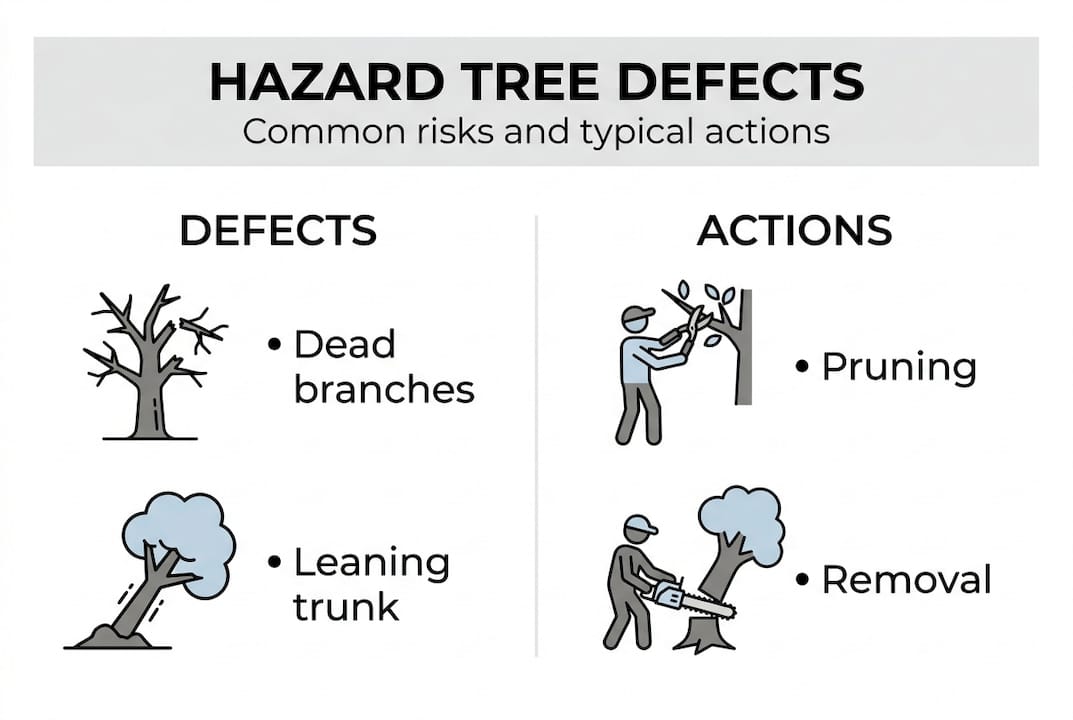
Arborists look for specific defects when assessing a tree. The most common ones include:
- Decay or hollow sections in the trunk or major branches
- Root damage or instability, often caused by construction, soil compaction, or disease
- Significant lean, especially when it developed suddenly after a storm
- Cracks or splits in the trunk or major branch unions
- Dead branches (known as widow-makers) sitting high in the canopy
- Storm damage that has compromised the tree’s structural integrity
- Fungal growth at the base, which often signals internal decay
Here’s a useful way to think about risk levels:
| Defect type | Risk level | Typical action |
|---|---|---|
| Minor dead branches | Low | Pruning |
| Significant lean with root lift | High | Urgent assessment |
| Hollow trunk with targets nearby | Very high | Immediate review |
| Storm-split major branch | High | Priority removal or bracing |
| Fungal growth at base | High to very high | Expert inspection |
Most trees that end up being removed have multiple major defects rather than just one isolated issue. A single crack doesn’t automatically mean removal. But a crack combined with a hollow trunk and a lean toward your roof? That’s a very different conversation.
As a homeowner, it’s worth doing a visual check after every major storm. Walk around your trees, look for new cracks, leaning, or branches that weren’t there before. If something looks off, don’t wait. Understanding local arborist regulations in your area will also help you know when action is legally required.
How experts assess tree risk
With the signs and risks clear, the next step is expert evaluation. How does a qualified arborist actually decide whether a tree needs to come down?
The process starts with an initial site inspection. The arborist looks at the whole picture: the tree’s species, age, size, location, and what’s around it. From there, the assessment moves through defined levels, from a basic visual check to a detailed technical evaluation using specialised tools.
Here’s how the levels typically work:
- Level 1 (Limited visual assessment): A drive-by or walkthrough to flag obvious concerns.
- Level 2 (Basic assessment): A ground-level inspection using binoculars and basic tools, covering the whole tree.
- Level 3 (Advanced assessment): Includes climbing, resistograph drilling, or sonic tomography to detect internal decay.
Arborists in NSW use recognised methodologies to structure their assessments. These include TRAQ, QTRA, VALID, and VTA, which evaluate the likelihood of failure, the potential for a target to be struck, and the consequences if that happens. These aren’t just acronyms. They’re structured frameworks that help arborists make defensible, consistent decisions.
Why does this matter for you? Because councils and insurers increasingly want documented evidence before approving removal or processing claims. A written arborist report is your paper trail. It protects you legally and financially.
When choosing who to hire, look for a qualified arborist with the right certifications, and read up on finding a good arborist before you commit.
Pro Tip: Always ask for a written arborist report after any inspection, and take your own dated photos of the tree beforehand. If you ever need to dispute a council decision or make an insurance claim, that documentation is invaluable.
How hazard tree removal is carried out safely
Once a tree is confirmed as hazardous, safe removal is a coordinated process. It is absolutely not just a bloke with a chainsaw.
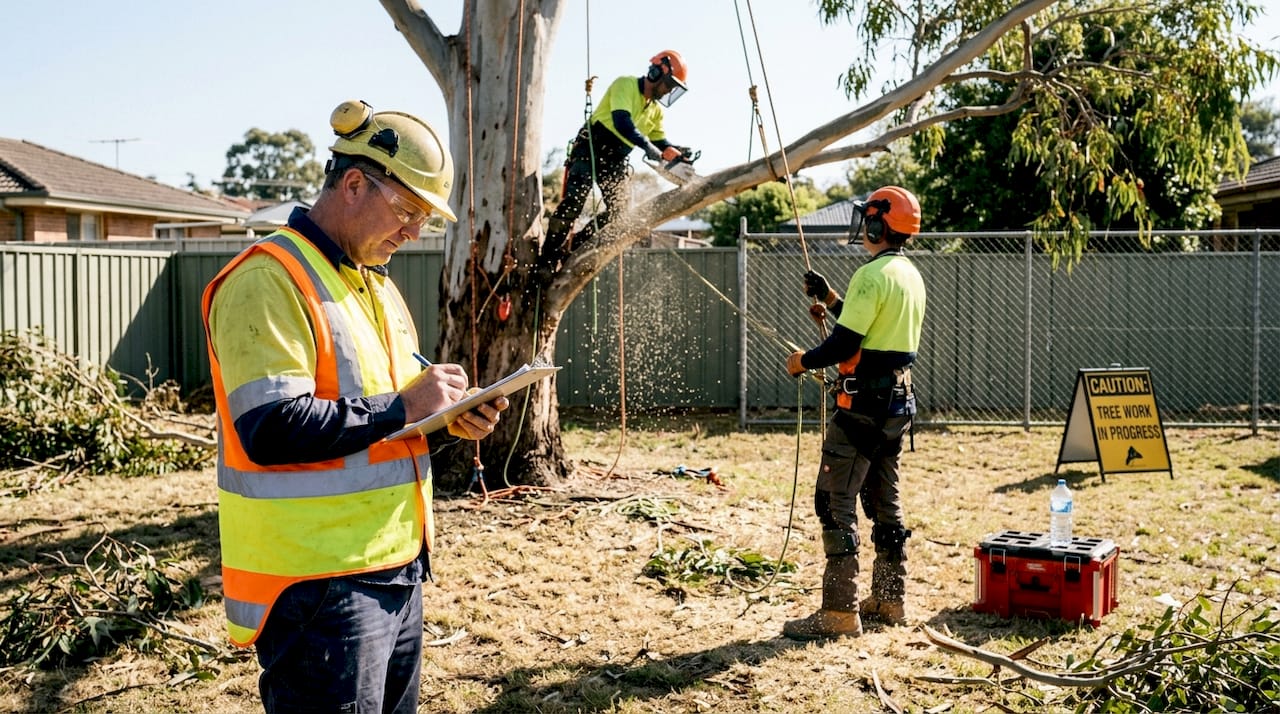
Professional hazard tree removal in urban NSW typically follows these steps:
- Site assessment and planning: The team reviews access, overhead lines, nearby structures, and escape routes.
- Setting up exclusion zones: The public and residents are kept clear of the work area.
- Rigging and climbing: A qualified climber ascends the tree and attaches rigging ropes to control how sections fall.
- Sectional dismantling: The tree is removed piece by piece from the top down, with each section lowered using pulleys and lowering devices.
- Ground crew management: Ground crew guide lowered sections, feed material into the chipper, and keep the site clear.
- Stump grinding or removal: The stump is addressed based on your preference and the site requirements.
- Full site clean-up: All debris is removed, and the site is left tidy.
For trees near structures or in tight urban spaces, sectional dismantling with rigging is the preferred method. Crane-assisted removal is used for very large or inaccessible trees. Straight felling, where the whole tree is dropped in one go, is rare in suburban NSW due to space constraints.
?The safest method isn’t always the quickest or cheapest. Proper rigging and a full crew take time, but they’re what keep your home and your neighbours? properties intact.?
A professional tree services team will always include a safety supervisor on site. Duration depends on tree size and complexity, but most suburban removals are completed within a day.
Pro Tip: Before work begins, get written confirmation that full clean-up is included in your quote. Some operators leave stumps, chips, or debris behind unless it’s explicitly agreed upfront.
Legal rules, exemptions, and special NSW situations
Even if a tree is hazardous, the law in NSW has strict rules. Getting this wrong can result in serious fines, so it’s worth knowing exactly where you stand.
The good news is that not every hazardous tree requires council approval before removal. NSW law provides several key exemptions:
- Dead trees: Generally exempt from permit requirements, but document the condition with photos first.
- Dying trees: Where the tree poses an immediate risk, exemptions often apply.
- Immediate danger situations: If a tree poses an imminent risk to life or property, emergency removal may proceed without prior approval.
- Small trees: Many councils exempt trees under a certain height or trunk diameter.
- 10/50 bushfire rule: In mapped bushfire-prone areas, you can clear trees within 10 metres of your home without council approval.
For everything else, you’ll need a permit. This typically requires a formal application and, in many cases, a Level 5 arborist report to support your case. The common tree removal scenarios guide from Shellharbour Council gives a practical sense of how councils approach different situations.
Special cases that often catch homeowners out include storm-damaged trees (where emergency works are allowed but must be documented), trees near power lines (which involve Ausgrid or Essential Energy, not just your council), and neighbour trees that overhang your property.
Pro Tip: Always check with your local council before removing any tree, even one that looks obviously dead or dangerous. A quick phone call or council website check can save you a fine of several thousand dollars.
For help navigating the local council approval process or understanding the guide to permit requirements in your area, it’s worth getting professional advice early.
Our perspective: why expert judgement, not just removal, matters most
Here’s something we’ve seen time and again in our years of NSW tree care: the instinct to remove is often stronger than the evidence for it. A homeowner sees a big tree leaning toward their fence and immediately wants it gone. Understandable. But removal isn’t always the right answer, and acting too quickly can cost you more than you’d expect.
Pruning, cabling, or bracing can address many structural issues while preserving a tree that adds real value to your property and neighbourhood. Mature trees can add thousands of dollars to a home’s value, and removing them unnecessarily strips that away permanently.
We also see the consequences of DIY or uninsured work regularly. Fines, voided insurance policies, and unsafe outcomes that end up costing far more to fix. Councils and insurers want expert involvement for good reason.
The best outcomes come from good arborist advice that weighs all the options, not just the fastest one. A genuine hazard plan considers what stays just as carefully as what goes.
Need help with hazard tree removal?
If you’ve spotted a tree on your property that’s giving you cause for concern, don’t leave it to chance. Hazard tree removal in NSW requires the right expertise, proper documentation, and full compliance with council rules. Getting it right from the start protects your family, your home, and your investment.
At True Roots, our team of qualified arborist services can handle everything from initial risk assessment through to council applications and safe, clean removal. We’re fully insured, AQF-certified, and genuinely passionate about doing the job properly. Reach out to our professional tree removal team today for an obligation-free assessment and real peace of mind.
Frequently asked questions
What is the 10/50 rule for hazard tree removal in NSW?
The 10/50 rule allows clearing trees within 10 metres of homes in mapped bushfire-prone areas without council approval. It applies only in designated zones, so check your property’s status before proceeding.
Can I remove a neighbour’s hazardous tree if it threatens my property?
No. You must notify your neighbour and cannot remove their tree without their consent, even if it poses a risk to your property. Seek legal advice if your neighbour is unresponsive.
Is council approval always needed for hazard tree removal?
Not always. If the tree is dead, dying, or poses an immediate danger, you may be exempt from requiring approval. Always check with your local council before acting to confirm your specific situation.
What qualifications should an arborist have for hazard tree removal?
Look for an AQF Level 3 to 5 qualified arborist to ensure proper assessment and legal compliance. Full insurance is equally important, so always ask for proof before work begins.
Recommended
- Emergency tree removal in Sydney
- Tree risk assessments
- Storm damage to trees: what to do next
- Arborist reports for councils and insurers
Related True Roots services
Need the real thing done? True Roots are AQF Level 5 arborists and landscapers, fully insured ($20M public liability) and rated 5.0 across the St George area, the Sutherland Shire and Canterbury-Bankstown. Explore tree removal, tree pruning, stump grinding, arborist reports, 24/7 emergency tree work and landscaping & gardening — or get a free quote today on 0422 023 242.
Get a free quote
Tell us what you need done and we will get back to you within 1 business day. Every job is assessed individually - no two trees are the same.
Urgent or unsafe tree? Call 0422 023 242 - we answer 24 hours.
